Blues / Blues rock & the British blues boom · 1966
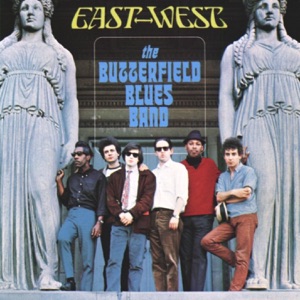
East-West
The Paul Butterfield Blues Band
Why listen
Two extended instrumentals stand beside shorter blues and pop songs, showing a band enlarging its range without abandoning compact forms.
Listen and read
Tracks · previews
English editorial edition
Album story
The final thirteen minutes can dominate the memory of East-West, but eight other tracks lead there. Walkin’ Blues, Get Out of My Life, Woman and Mary, Mary bring different song sources and proportions into the programme. The extended title piece shares an album with them rather than replacing them. Before jumping to the ending, use Work Song as an earlier entrance into the band’s expanded instrumental scale.
This 1966 second album features Butterfield, guitarists Mike Bloomfield and Elvin Bishop, keyboard player Mark Naftalin, bassist Jerome Arnold and drummer Billy Davenport. The previous album’s personnel should not simply be carried forward. Nor should the group be reduced to one guitarist’s achievement. Harmonica, keyboards and two guitars can exchange foreground and support, with instrumental passages allowing those relationships to develop beyond the dimensions of a short vocal song.
An earlier expansion
Work Song already opens a broad instrumental space in the fifth position. Hear it after All These Blues. The change in length allows different kinds of continuity between instrumental contributions, but length alone does not make a performance an arbitrary jam. Follow the theme and the accompaniment as reference points, rather than waiting for sung verses to define each section.
Compact songs still matter
Mary, Mary contracts the scale immediately afterward. Its inclusion also shows that the repertoire is not limited to one songwriting tradition. Keep Two Trains Running and Never Say No in place. Discovering an extended form did not require the band to discard shorter songs. Compare how accompaniment supports singing after it has occupied so much more of the foreground in the instrumental.
Understand the final track as an album performance
The title piece lasts approximately thirteen minutes and twelve seconds here. Attend to changing emphasis among the instruments rather than expecting another vocal verse. Its placement after eight other selections contributes to its scale. Separate this released album performance from later or longer live renditions, and do not mistake the original album edit for an unedited record of everything the musicians played.
The album through its tracks
Hear All These Blues, Work Song and Mary, Mary in order, then retain the complete sequence through the closing East-West.
Work Song
The fifth selection lasts approximately 7:55. This instrumental treatment of Nat Adderley’s composition supplies an earlier expansion than the celebrated closing track. Put it between All These Blues and Mary, Mary to hear how a broad performing space occupies the middle of shorter songs. Follow the accompaniment occasionally instead of attending only to the featured instrument. Does the sense of direction continue when one player yields the foreground, and how does a familiar theme change when another sound takes responsibility? Those questions give the duration a shape without requiring a detailed transcription. The selection is the original album’s complete fifth track, not another musician’s jazz recording or a later live substitution.
Reference · Qobuz / Rhino-Elektra: original nine-track programme, writers and durationsEast-West
Bloomfield and Nick Gravenites receive the writing credits for this ninth selection. At approximately 13:12, the chosen album performance must be distinguished from longer live versions. Rather than expecting the same intensity throughout, follow shifts of emphasis around a continuing instrumental foundation. Listen once from Never Say No so that the expansion after a vocal song remains part of the experience. Musical influence does not require claiming that the band reproduces another tradition’s complete formal practice. Distinguishing guitars, harmonica and keyboards offers a practical starting point. The original released album edit is retained here; that description does not imply an unedited session tape or a record of every minute played in concert.
Reference · Qobuz / Rhino-Elektra: original nine-track programme, writers and durations
Listen next
Return to The Paul Butterfield Blues Band and compare its compact programme with the enlarged instrumental durations on the second album.
The Paul Butterfield Blues Band ↗References & editorial note
Written for English readers. Album facts are referenced below; listening suggestions are editorial interpretations. AI-assisted editorial review; not independently human-reviewed.
- Michael Bloomfield official discography: 1966 album lineup, nine titles and separate live versions · www.michaelbloomfield.com
- Qobuz / Rhino-Elektra: original nine-track programme, writers and durations · www.qobuz.com
- Apple Music: nine-track East-West delivery · music.apple.com
- Apple Music / Elektra: same programme on disc two of Complete Albums 1965–1980 · music.apple.com