Classical / Medieval & Renaissance · 1987
Dufay: Motets
Hilliard Ensemble
뒤파이: 모테트집 · 힐리어드 앙상블
Why listen
Choose one voice, then turn towards what remains beneath it. The music becomes a relationship between moving lines rather than an unfamiliar historical label.
Listen and read
Tracks · previews
English editorial edition
Album story
Start with Nuper rosarum flores and follow the line that reaches you most clearly. After a while, change your attention to another voice. Singing together does not require every part to do the same thing: one may seem to linger while another moves forward. That difference offers an entrance before you learn a period name or understand the Latin. Notice which voice you begin to anticipate, rather than trying to explain the entire texture at once.
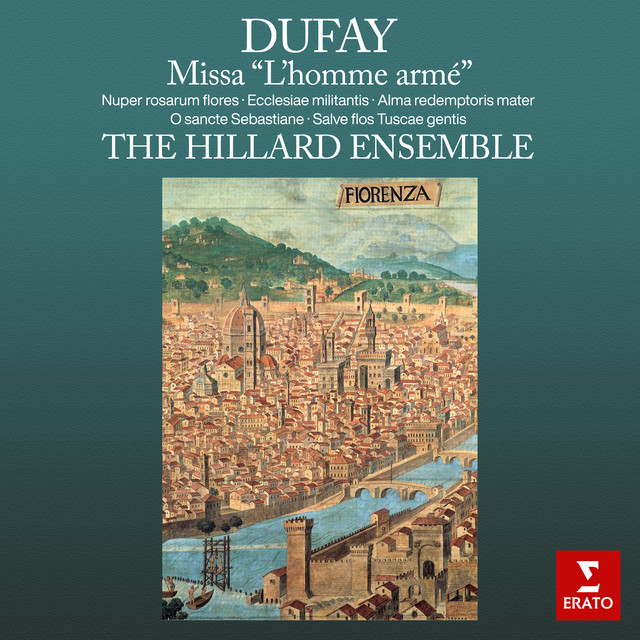
The site’s shortened title, Motets, does not describe the whole linked programme. The Hilliard Ensemble’s album is Missa L’homme armé & Motets, issued in 1987. That is the modern release date, not the date of the fifteenth-century music. Its first five tracks are movements of the Mass; five motets follow. You can begin in the second half and return to the Mass later without treating all ten tracks as unrelated motets.
Change your point of attention
If the sound feels crowded, choose a high line on one visit and something lower on the next. The same performance may leave a different impression. Ask whether an overlap creates tension, or whether a shared ending offers release. You need not define polyphony to hear several lines sharing space. Let some details remain outside your attention; they can provide a reason to return.
An old occasion, a modern recording
Nuper rosarum flores belongs to the 1436 dedication of Florence Cathedral. This recording is not a preserved sound of that event, but modern musicians giving written music a performed shape. You do not have to reconstruct a medieval listener’s faith or surroundings. In your own room, follow what feels close and what spreads into the distance. Historical context and immediate response can support each other without becoming the same task.
Begin at track six, then try track eight
Nuper rosarum flores lasts about 6:47 on this edition; Alma Redemptoris mater II, at track eight, lasts about 3:57. Try the longer piece beside the shorter one and notice whether following a voice changes your expectation of an ending. Once both feel familiar, return to the opening Kyrie, a Mass movement. This small route offers a practical alternative to tackling all ten tracks at once. Duration is not a measure of difficulty, and a preview supplies only part of the journey.
The album through its tracks
Compare Nuper rosarum flores with Alma Redemptoris mater II. The ten-track UK edition begins with five Mass movements.
Nuper rosarum flores
When one voice comes forward, listen for what the others continue to do. Shifting your attention can make a long piece feel like changing scenes. The University of Exeter’s Hidden Florence project associates the work with the cathedral dedication on 25 March 1436. That gives the music a public ceremonial setting, without requiring you to imagine a building while listening. Notice instead how an arrival of voices changes your sense of space, and what you anticipate when the texture opens again. You need not solve a question about architectural proportions to begin. Follow how several parts divide the time, keeping a useful distinction between this modern performance and the historical occasion that prompted the work.
Reference · Fabrizio Nevola, University of Exeter, Hidden Florence: Flowers and florinsAlma Redemptoris mater II
Move here after the larger preceding pieces and compare the effort of following a line. The linked ten-track programme places this eighth, and its final II is worth preserving when searching for the recording. A familiar Latin title does not guarantee an identical composition or performance elsewhere. For listening, begin with the time after a phrase: how much space do you feel before another entrance? Do you still remember one line when the next attracts your attention? Compare the appeal of a sustained sound with the expectation of something more active. Recognition of a title can become a practical reason to listen again, rather than the end of the encounter. A comfortable volume is enough.
Reference · Apple Music / Warner: Dufay, Missa L’homme armé & Motets, 1987 programme
Listen next
Continue with the same ensemble’s Machaut: Messe de Nostre Dame and compare the meeting of voices and the time given to a phrase.
Machaut: Messe de Nostre Dame ↗References & editorial note
Written for English readers. Album facts are referenced below; listening suggestions are editorial interpretations. AI-assisted editorial review; not independently human-reviewed.