Folk / Country / Folk revival · 1963
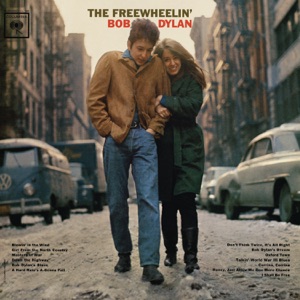
The Freewheelin' Bob Dylan
Bob Dylan
Why listen
A spare setting gives questions, anger, parting and jokes sharply different speaking voices.
Listen and read
Tracks · previews
English editorial edition
Album story
The guitar can keep its pattern while a sentence refuses to settle comfortably. Dylan holds a question open, then elsewhere sounds almost casual about a parting. The Freewheelin’ Bob Dylan brings public concerns and private feelings into the same close listening distance. Its force is in the delivery as well as in the words that later became famous.
This second album, released in 1963, greatly expands the place of Dylan’s own writing. That does not mean every song begins outside an inherited tradition. Folk forms and earlier material remain part of the vocabulary through which new lines arrive. Begin with how a sentence is sung rather than treating literary reputation as a substitute for hearing the performance.
What a small accompaniment reveals
In the songs centred on voice, guitar and harmonica, phrase length and breath become major events. The backing need not continually change the scenery: an emphasis or a different ending can alter the mood. Compare the questioning in Blowin’ in the Wind, the confrontation of Masters of War and the accumulating images of A Hard Rain’s a-Gonna Fall. Before explaining every line, hear where the voice presses and where it releases.
More than a public spokesman
Girl from the North Country and Don’t Think Twice, It’s All Right retain their intimate scale beside the public songs. The talking blues and comic turns later in the programme are not simply interruptions of seriousness. Anger, tenderness, self-protection and amusement enlarge the same voice. Hear an album assembled from contrasting performances rather than assuming a single uninterrupted solo concert. The closing humour of I Shall Be Free can change how the opening questions linger.
Then, later, and this edition
Nat Hentoff’s original liner notes foregrounded the songwriting and its musical force; they are a contemporary presentation of the record, not a neutral later history. Elizabeth Thomson’s Library of Congress retrospective revisits that development, and the album entered the National Recording Registry in 2002. Its first UK chart appearance came in 1964, so its eventual number-one peak should not be described as an immediate 1963 result. The linked 2010 mono edition preserves the thirteen-track programme. It is neither a new performance nor an expanded set of additional songs. Return to the delivery and familiar forms can sound newly unsettled.
The album through its tracks
Follow the guitar, then compare how long each vocal sentence ending remains in the air.
Blowin' In the Wind (2010 Mono Version)
Questions accumulate inside a melody that keeps returning. The refrain therefore need not feel identical each time, even when its shape is familiar. Start with the regular guitar movement and notice how the voice leaves the end of a sentence hanging. If you know the song through communal singing, attend instead to the dry closeness of this particular solo delivery. A tune that many people can share and a voice that seems to address one person coexist here. Hentoff’s original notes discuss the song, but you need not adopt a fixed interpretation to hear its resistance to an easy conclusion. Small repetitions keep the act of questioning alive.
Reference · Bob Dylan official: original programme and Nat Hentoff liner notesDon't Think Twice, It's All Right (2010 Mono Version)
The guitar continues while the voice drops remarks that seem to be putting a relationship behind it. Do not immediately equate a casual manner with emotional peace. Compare the pressure at a phrase ending with the unbroken movement underneath. The speaker may sound as though he is addressing someone else and persuading himself at once. That is a possible reading of the performance, not proof about a particular lover’s life. Follow the vocal once, then give the guitar pattern your attention on another pass. The difference in temperature between them becomes more audible. Beside the album’s public arguments, this intimate register shows how tension can persist without a dramatic outburst.
Reference · Bob Dylan official: original programme and Nat Hentoff liner notes
Listen next
Continue with Joan Baez’s 1960 debut to compare a clear melodic line and a rougher conversational delivery within inherited folk forms.
Joan Baez ↗References & editorial note
Written for English readers. Album facts are referenced below; listening suggestions are editorial interpretations. AI-assisted editorial review; not independently human-reviewed.