Hip-hop / Alternative & jazz rap · 1993
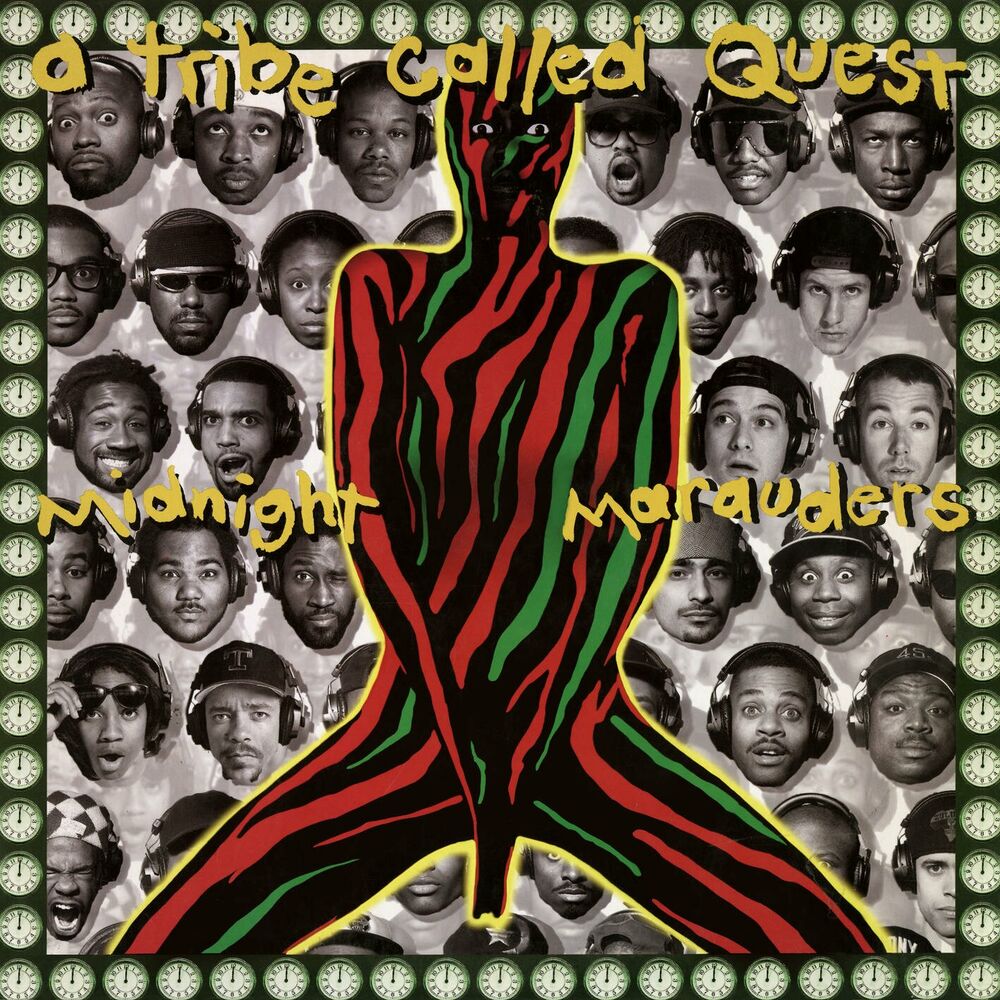
Midnight Marauders
A Tribe Called Quest
Why listen
A repeating beat becomes a conversation as voices give the same pulse different lengths and accents.
Listen and read
Tracks · previews
English editorial edition
Album story
Begin with the drums, then notice how a rapper’s sentence settles against them. On Midnight Marauders, a change of voice can make a stable pattern feel newly shaped. The bass provides a strong reference, but phrasing keeps moving the centre of attention.
A Tribe Called Quest released their third studio album on9 November1993. The official artist store and Sony Legacy both document the fourteen-track programme, opening with Midnight Marauders Tour Guide. Q-Tip, Phife Dawg and Ali Shaheed Muhammad form the central group context; individually credited guests should be heard as distinct participants.
Follow the handover
Award Tour provides an inviting entrance, with Trugoy the Dove explicitly credited in the official programme. Listen for the transition between rapping and the returning refrain rather than hearing every vocal as one continuous speaker. Then revisit the preceding Steve Biko and compare sentence lengths against the drums. A change in articulation may alter the apparent movement without any actual change of tempo. Simple labels for each rapper’s personality are less useful than hearing where a particular phrase pauses and resumes.
Put the singles inside the journey
The short tour-guide opening frames a sequence broader than its best-known songs. Keep the intervening tracks in place as the album passes through8 Million Stories, Midnight and We Can Get Down. Electric Relaxation then offers a softer-seeming surface on which to hear detailed rhythmic placement. A title or attractive backing does not summarise every lyrical attitude. Separate the pleasure of hearing the flow from claims about the complete meaning of the words.
A stable frame, changing occupants
The official credits also identify Busta Rhymes on Oh My God and Large Professor on Keep It Rollin’. Hear those arrivals as changes within the group’s larger sequence, then continue through The Chase, Part II and Lyrics to Go to God Lives Through. Knowing sample sources can enrich another visit, but the album need not become an identification quiz. Its immediate pleasure is the relationship between an insistent recurring foundation and speech that keeps giving it a different shape. The linked Zomba edition retains the original fourteen tracks, making that complete sequence available without bonus material changing its endpoint.
The album through its tracks
Remember the drum pattern, then follow changes in sentence length, accent and pause as voices enter.
Award Tour (feat. Trugoy the Dove)
Memorise a short part of the backing before following the rap. Notice how long a sentence stretches over it, then hear the change of scale when the refrain returns. The official programme identifies Trugoy the Dove’s participation, and this is track three in the original sequence. Do not automatically assign every voice to the group’s two principal rappers. On a second pass, keep the drums in mind while following how pronunciation moves around their regular positions. An inviting chorus does not make the rhythmic detail simple. Returning music can feel different after a phrase of another length has passed over it, making familiarity part of an active exchange.
Reference · ATCQ official store: original1993 release and14-track programmeElectric Relaxation
The gentle-seeming repetition can recede into the background until you choose a phrase ending or short pause to follow. Listen to the low movement first, then to the meeting points between articulation and drums. This is track eight and opens the second side in the official LP listing, following We Can Get Down. Restoring that context makes the change in atmosphere more noticeable. The title does not turn the song into anonymous background music, nor does a smooth surface summarise every lyrical attitude. Here, concentrate on how different voices occupy the same short foundation. Repetition becomes a space shaped by speech rather than an unchanging frame around it.
Reference · Apple Music US:1993Zomba explicit collection
Listen next
Compare Digable Planets and Reachin’ for another1993 approach to arranging voices and recurring instrumental material.
Reachin' (A New Refutation of Time and Space) ↗References & editorial note
Written for English readers. Album facts are referenced below; listening suggestions are editorial interpretations. AI-assisted editorial review; not independently human-reviewed.