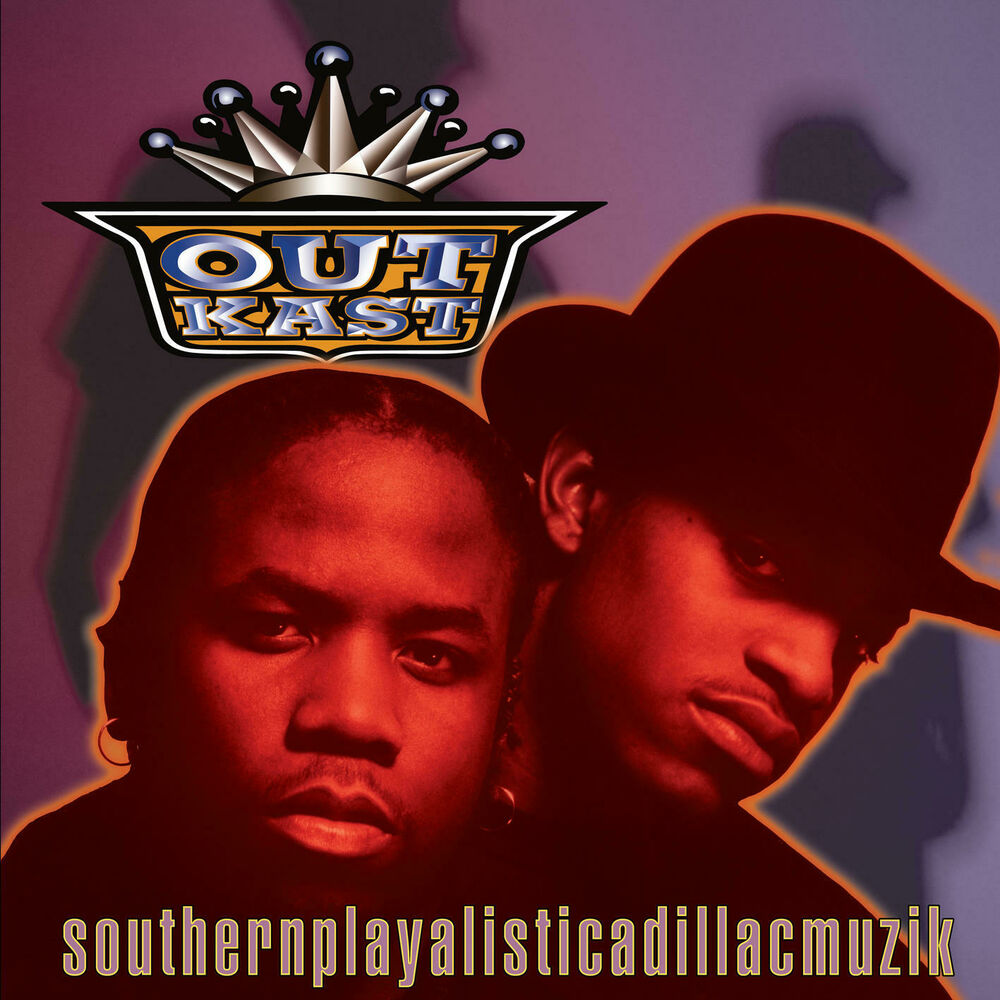
Hip-hop / Southern hip-hop & Dirty South · 1994
Southernplayalisticadillacmuzik
OutKast
Why listen
Live playing, beats, sung hooks and contrasting rap voices turn an Atlanta debut into a varied sequence of scenes.
Listen and read
Tracks · previews
English editorial edition
Album story
Southernplayalisticadillacmuzik lets an easy-moving backing coexist with rap that is anything but idle. André and Big Boi share the groove without shaping every phrase in the same way, while melodic hooks introduce another texture between verses. The result is not one definitive Southern tempo or attitude. It is a portrait populated by two young rappers and the people working around them.
Released in 1994 through LaFace, OutKast’s debut contains seventeen tracks when its interludes and final reprise are retained. Organized Noize—Rico Wade, Ray Murray and Sleepy Brown—produced the album. Their use of played instruments should not be mistaken for an absence of sampling. In a later NPR interview, the producers recalled how the expense of sample clearance pushed them further toward developing music through performance.
Naming a place without closing its borders
Welcome to Atlanta leads into the title track, an effective transition from introduction to an extended musical statement. Yet calling this the South’s first hip-hop record would erase earlier artists. Murray described inspiration reaching from New York to Oakland. The local identity comes from choosing and reshaping material around the lives they knew, not from refusing every outside influence or inventing a scene from nothing.
More than two voices
Goodie Mob appears on Call of da Wild and Git Up, Git Out. The latter lasts about seven minutes twenty-seven seconds, making substantial room for a shared performance. Short interludes on either side emphasize its scale. The album’s seventeen entries are therefore not seventeen interchangeable songs: brief appearances and extended exchanges have different functions, giving the programme the changing proportions of a populated place.
A hit becomes an ending
Player’s Ball first appears seventh, then returns in a separate reprise at the very end. Its second appearance follows Funky Ride, the long collaborative track and the remaining scenes, so familiar material now carries a memory of the intervening record. The earlier Christmas single is also distinct from the album presentation. Establishing a hit and using its material to close a full album are related but different production decisions.
The album through its tracks
Connect the main Player’s Ball to its closing reprise, and compare that return with the extended shared performance of Git Up, Git Out.
Player's Ball
The sung hook helps make the relaxed groove a setting for both rappers rather than merely a backing under separate verses. The song first appeared as a Christmas single, a plan L.A. Reid recalled proposing in his Recording Academy interview. This selection uses the album’s seventh track, not a substitution from that earlier single. Its approximately four-minute-twenty-one-second length also distinguishes it from the closing reprise. Consider how the hook joins the voices, then remember that sound when its material returns at the end. A successful single can have one effect within the sequence and another when it becomes the basis of a familiar farewell.
Reference · Recording Academy — interviews with Ray Murray, L.A. Reid and André BenjaminGit Up, Git Out
Goodie Mob joins OutKast on a performance lasting about seven minutes twenty-seven seconds. That extended space makes the debut’s collaborative world concrete: the two principal rappers are part of a larger exchange. A recurring hook and repeated backing connect the changing voices rather than leaving the track as a stack of unrelated statements. Its placement between the short Flim Flam and True Dat interludes sharpens the sense of scale. Instead of ranking it as the album’s heaviest message, follow how the performance keeps moving while giving several speakers time. The contrast with the surrounding fragments shows that duration itself is one of the album’s organizing choices.
Reference · Sony Music Canada — full seventeen-track programme
Listen next
ATLiens follows two years later with changes in production and musical space. Compare those choices while preserving the debut’s collective character as a complete achievement of its own.
ATLiens ↗References & editorial note
Written for English readers. Album facts are referenced below; listening suggestions are editorial interpretations. AI-assisted editorial review; not independently human-reviewed.
- Sony Music Canada — full seventeen-track programme · shop.sonymusic.ca
- NPR Microphone Check / WUNC — Organized Noize interview on production · www.wunc.org
- Recording Academy — interviews with Ray Murray, L.A. Reid and André Benjamin · www.grammy.com
- Qobuz / Arista — seventeen-track delivery and production credits · www.qobuz.com
- Apple Music — complete seventeen-track explicit album · music.apple.com