Jazz / Swing & big bands · 1950
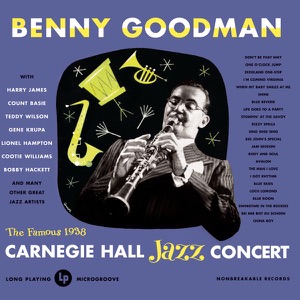
The Famous 1938 Carnegie Hall Jazz Concert
Benny Goodman
Why listen
A swing concert whose changing ensemble sizes make room for both collective force and intimate musical conversation.
Listen and read
Tracks · previews
English editorial edition
Album story
The attraction is not simply a big band playing at full power. When Benny Goodman moves from orchestra to trio or quartet, the available space changes. A clarinet phrase can suddenly feel close and exposed. Applause and the intervals between performances add another presence: an audience responding as the evening takes shape.
The event took place in New York on 16 January 1938; Columbia first released the concert recording in 1950. Keeping those dates separate helps explain the album. Its reputation belongs both to a particular night and to the later opportunity to revisit that night on record. Guests and changes of ensemble offer different ways of organising the same underlying swing pulse.
Listening without losing the dance
Calling this the first jazz event at Carnegie Hall erases earlier programmes. In her Library of Congress essay, Catherine Tackley places Goodman within an existing history of concert presentations of popular and African American music. The important listening question is what a seated audience can notice. Short ensemble responses, longer solo phrases and shifts in texture become events to follow. The dance impulse remains inside the rhythm even when the listeners are not on a dance floor.
The night and its afterlife
Goodman’s official account records an advance sellout. Audience responses preserved on the recording are another trace of the occasion. These should be distinguished from the acclaim that followed the 1950 album and later restored editions. The racially mixed small groups and guest performances also matter historically, without implying that one concert dissolved segregation throughout the music business. The programme lets different musicians share a stage; its history should retain those individuals rather than turning everything into a single bandleader’s triumph.
Reading the expanded edition
The digital edition used here has 49 tracks, not 49 separate compositions. Applause, transitions, pauses and spoken material receive their own entries, and the opening 1950 introduction is not a 1938 stage announcement. Compare “China Boy” with “Sing, Sing, Sing” before returning to the full sequence. In the trio, notice how room is made for a player to continue; in the orchestra, follow the arrivals of individual voices over a persistent foundation. The spaces between tracks help recover the evening’s scale, even though the modern indexing differs from the original album.
The album through its tracks
When the soloist changes, listen to the number and function of the instruments remaining behind the lead voice.
China Boy (Live)
Without the surrounding mass of a big band, Goodman’s clarinet becomes easier to follow as a sequence of decisions. Teddy Wilson’s piano supplies both harmonic movement and rhythmic support, while Gene Krupa gives the trio its propulsion. Attend to the encouragement for Goodman to continue with another chorus: another circuit through the tune’s framework. The request makes the performance feel open to decisions taken in the room, rather than fixed to the duration of a short record side. Instead of waiting for a spectacular climax, notice how two players maintain a place for the third to keep speaking. Intimacy and speed need not pull in opposite directions.
Reference · Library of Congress: Stan Ayeroff performance guideSing, Sing, Sing (With a Swing) [Live]
Use the recurring rhythmic foundation as a point of reference, then listen for changes in the amount of space surrounding a soloist. The orchestra can sound like one large body before separating into individual voices. This concert version allows the solos more room than the contemporary studio recording, so familiarity with a shorter version can be misleading. Wait for the next musical sentence rather than an expected ending. Length here is not simply a matter of sustaining maximum volume. On a second hearing, mark the places where the ensemble draws back. A performance can maintain forward pressure while briefly opening an area in which one player can change the atmosphere.
Reference · Library of Congress: Catherine Tackley on1938concert and1950release
Listen next
Continue with Count Basie’s The Original American Decca Recordings to hear contemporary swing compressed into shorter studio performances.
The Original American Decca Recordings ↗References & editorial note
Written for English readers. Album facts are referenced below; listening suggestions are editorial interpretations. AI-assisted editorial review; not independently human-reviewed.