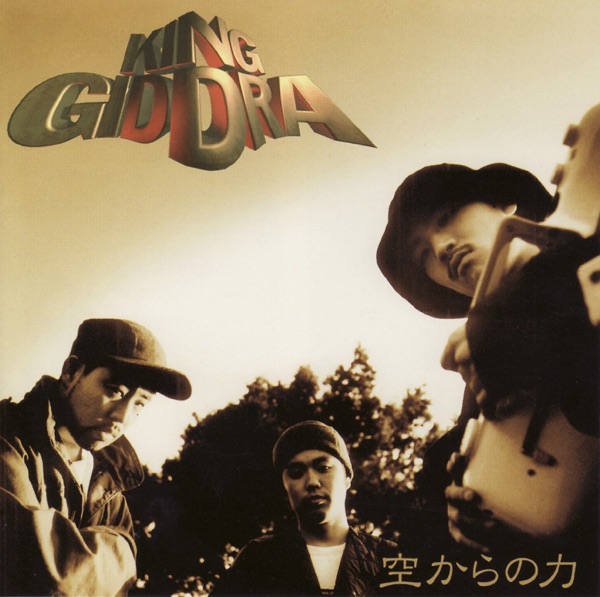
Japanese Music / Japanese-language hip-hop · 1995
Sora Kara no Chikara
King Giddra
空からの力 · キングギドラ
Why listen
Two contrasting MCs make the rhythmic shape of Japanese speech the centre of the record. Later musicians recalled it as a model to learn from; begin with the voices and beats that made such attention possible.
Listen and read
Tracks · previews
English editorial edition
Album story
Before you understand every sentence, the endings of phrases register against the beat. On Sora Kara no Chikara, two voices take turns at the front while repetition makes their differences clearer. Listen for the handover between them: it gives an immediate foothold even without Japanese fluency.
King Giddra brought together K DUB SHINE, Zeebra and DJ OASIS. Their 1995 debut became a recurring reference in discussions of Japanese rap. That does not mean hip-hop in Japan began here. Earlier artists had already spent years working with the form. This album is best approached as a distinctive answer within that history, rather than an origin story which erases it.
Hear the voices before solving every line
Start by distinguishing the MCs. Their weight and attack can make the same beat feel different. Understanding the words adds another dimension, but the length of a phrase and its stressed ending already create movement. A repeating backing does not necessarily produce a static performance. If rap seems to mean simply speaking quickly, the interaction here offers a more useful place to begin: delivery changes what repetition feels like.
The view extends beyond the microphone
Songs including “Mimawasou” and “Yukue Fumei” make it difficult to reduce the album to competitive self-presentation. The speakers also look outward. You need not agree with every position to notice how conviction shapes their delivery. Equally, these voices should not stand in for a whole country’s opinions in 1995. Keep the pleasure of the beat beside the questions raised by the words, allowing each to complicate the other.
Learning from a record, looking back at a scene
The introduction to ele-king’s 2015 interview discusses later musicians Cypress Ueno and SITE recalling the album as something they learned from. That is a specific retrospective response, not a survey of its original audience. The twentieth-anniversary reissue and interviews show continued attention without supplying an invented sales story. Our reason for including it is this combination of creative usefulness to subsequent musicians and an audible relationship between contrasting voices and insistent beats. Its historical reputation can guide a first listen without dictating what you must enjoy.
The album through its tracks
These entries connect songs with the album’s perspective. Later assessments of the whole record are not presented as contemporary chart evidence for an individual track.
Mimawasou · Look Around
The title offers a useful starting action: turn attention outward. More than a summary saying that the song has a message, listen to the effect of an address directed at the listener over a repeating beat. Following the changes of voice works even before the language becomes familiar. Later, understanding the words can change the tension you hear in that rhythm. The retrospective description of the album as a model for younger rappers concerns the record as a whole, not documented mass reception of this particular track in 1995. Here, the song provides a concrete way to explore how speech gains force by being organised as music.
Reference · ele-king: KGDR interview and retrospective, 2015Yukue Fumei · Missing
This track helps resist hearing the entire record as one extended competitive introduction. Attend to the unease suggested by the title and to the movement of the spoken lines, then compare the impression with “Mimawasou”. The same performers need not create the same tension. The album’s twentieth-anniversary reissue brought renewed interviews and reflection; that is evidence of later attention, not proof that this individual song was a chart hit. Its place here encourages listening beyond a single emblematic track. First notice differences of sound and delivery, then return to the perspective of the speaker. Historical importance becomes more interesting when it opens listening possibilities instead of replacing them.
Reference · ele-king: KGDR interview and retrospective, 2015
Listen next
Utada’s First Love offers another meeting of Japanese words and rhythm. This is a listening comparison, not a claim of direct influence: set rap delivery beside an R&B singer’s phrasing.
First Love ↗References & editorial note
Written for English readers. Album facts are referenced below; listening suggestions are editorial interpretations. AI-assisted editorial review; not independently human-reviewed.