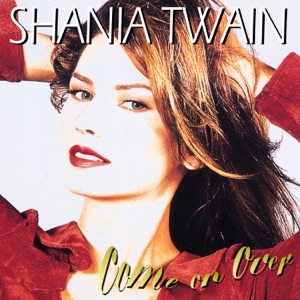
Pop / 1990s pop · 1997
Come On Over
Shania Twain
Why listen
Country instruments and large pop choruses share a long programme whose changes of pace matter as much as its individual hits.
Listen and read
Tracks · previews
English editorial edition
Album story
The US Come On Over begins with Man! I Feel Like a Woman!, placing an immediate guitar shape and an expansive chorus at the entrance. Sixteen tracks then alternate brisk invitations with slower declarations. The album’s accessibility does not depend on making every song behave alike. Instead, clearly marked choruses give very different moods a common frame, while changes in length keep the sequence moving through several distinct scales.
In the official anniversary announcement, Shania Twain recalled wanting to include her strongest material rather than hold songs back. Robert John “Mutt” Lange produced the original North American album, whose country instrumentation and rock guitar gestures coexist within pop structures. The later international edition changed both sequence and production. Following the US order here makes its particular dramatic choices clear: the assertive opener and the much later You’re Still the One occupy different kinds of space.
Expansion followed by compression
After four relatively compact opening tracks, From This Moment On broadens the scale with a duet featuring Bryan White. It lasts over four and a half minutes. The title track then brings the form below three minutes again. Rather than trying to outgrow each preceding song, the programme repeatedly contracts and starts afresh. Its substantial running time is organised through these shifts, not simply through a continuous rise in volume.
A ballad inside the sequence
You’re Still the One appears tenth, after If You Wanna Touch Her, Ask! Its measured melodic delivery provides a different way of expressing certainty. Honey, I’m Home and That Don’t Impress Me Much follow, returning the album to more outward gestures. The slow song therefore becomes a point of contrast within the programme rather than a signal that the energy has permanently subsided.
The final change of temperature
Rock This Country! is the penultimate track, leaving You’ve Got a Way to close more gently. That decision matters after such an extroverted beginning. The album does not end by making its opening declaration even louder. It allows warmth to follow spectacle, completing a sequence that repeatedly changes the size of its emotions while keeping the songs immediately legible.
The album through its tracks
Compare the opener’s immediate entrance with the tenth track’s slower expression of certainty.
Man! I Feel Like a Woman!
The opening guitar figure gives the song an instantly recognisable shape, while the vocal places short phrases against a firm rhythmic foundation. The chorus opens outward without abandoning that clear outline. As the first track in the US programme, it announces the record’s confidence before any ballad has time to soften the entrance. The three brisk songs that follow turn the opening gesture into a sustained stretch of momentum. Comparing this placement with You’re Still the One later in the album reveals two ways of presenting conviction: one makes an immediate public entrance, while the other allows a melody to establish its assurance gradually.
Reference · Qobuz: licensed original US programme, times and creditsYou’re Still the One
A spoken entrance gives way to a melody with more room to settle than the album’s opener. The piano support and steady pulse keep the ballad moving, while the returning chorus makes repetition feel reassuring rather than insistent. In the US sequence it is track ten, so its calm arrives after a substantial run of contrasting songs. The livelier material immediately afterwards prevents it from becoming an isolated emotional summit. Its importance lies partly in that position: a moment of steadiness inside a large programme, giving the listener another measure of Twain’s confidence before the record changes pace again and continues toward its softer ending.
Reference · Qobuz: licensed original US programme, times and credits
Listen next
Continue with Spice for another way of arranging contrasting song types within an ambitious pop album.
Spice ↗References & editorial note
Written for English readers. Album facts are referenced below; listening suggestions are editorial interpretations. AI-assisted editorial review; not independently human-reviewed.