Rock / Early rock and roll · 1955–65
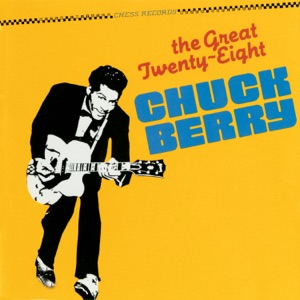
The Great Twenty-Eight
Chuck Berry
Why listen
Short guitar entrances and quick, conversational singing keep handing the song to each other. Start with the pleasure of that exchange, before treating these records as a history lesson.
Listen and read
Tracks · previews
English editorial edition
Album story
Try the starts of Maybellene and Johnny B. Goode together. In one, the voice seems eager to get the story moving; in the other, the guitar has your attention before anyone sings. Chuck Berry need not arrive as required homework on the origins of rock. These brief performances make their character apparent quickly. If your usual guitar music is heavier, listen for how much momentum can come from a compact entrance and a sharply delivered sentence.
The Great Twenty-Eight is a compilation released in 1982, rather than a studio album made in one session. The site’s 1955–65 dates identify the recording era represented, not the release date of this title. Its twenty-eight selections offer several ways into a performer’s work. The linked digital edition labels Sweet Little Sixteen as a Demo; matching the song count therefore does not establish that every take matches the original compilation.
Follow the singer after the guitar
Once an opening has caught you, attend to the pace of the words. Where does a crowded sentence give way to something you can join in with? You do not need to decode every line to hear that contrast. Play a favourite twice, following the instrumental responses on one pass and the voice on the next. A short recording can contain a surprisingly active conversation.
Success and commemoration are different evidence
The official biography records Maybellene reaching number five on the US pop chart and number one on the R&B chart in 1955. Berry’s Rock Hall induction came in 1986. Keep contemporary success separate from later recognition: neither warrants a claim that every audience responded alike. The records had listeners before they became monuments for later musicians.
Use the collection as a set of entrances
After the familiar titles, try Memphis, Tennessee or Havana Moon and ask whether the voice occupies the same space. There is no obligation to memorise all twenty-eight tracks in order. Choose one opening you like, then explore its neighbours. Looking for the source of a later band’s sound can be rewarding, but the speed, pauses and humour of these performances offer their own reasons to return.
The album through its tracks
Compare the quick delivery of Maybellene with the guitar entrance of Johnny B. Goode. Note the digital edition’s Demo label rather than assuming every take duplicates the original release.
Maybellene
Follow how the singer keeps the story moving while the accompaniment sustains its pace. The official biography’s 1955 chart positions—five on the US pop chart and one on the R&B chart—document a contemporary audience, not merely later admiration. They do not prove that racial barriers disappeared. Bring that distinction back to the recording: listen for where a sentence finishes, where the next begins, and how little space the instruments need to answer. Even without following every detail of the words, you can hear a contrast between packed delivery and a recurring refrain. It is a useful entrance into a song that tells a story while giving the body a pulse to follow.
Reference · Chuck Berry official biography: 1955 Maybellene chart receptionJohnny B. Goode
Recognising the guitar entrance is a beginning, not a reason to stop listening. Follow the arrival of the voice and ask whether it takes over the momentum or shares it. The Rock Hall’s retrospective account emphasises Berry’s guitar vocabulary and rhythmic storytelling; this is later assessment, not a contemporary review of the single. You can test a smaller proposition yourself. Does the brief guitar response between sung passages bring the opening back to mind? Listen once to the entrance and again to those returns. The interest lies less in the length of a solo than in how a compact musical gesture can give an entire song its identity, even after the singer has taken centre stage.
Reference · Rock & Roll Hall of Fame: Chuck Berry, 1986 induction and retrospective account
Listen next
Move to Elvis Presley’s 1956 album and compare how another early rock recording balances the singer’s rhythmic presence with the instruments around him.
Elvis Presley ↗References & editorial note
Written for English readers. Album facts are referenced below; listening suggestions are editorial interpretations. AI-assisted editorial review; not independently human-reviewed.