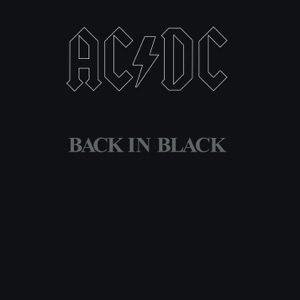
Rock / Hard rock & heavy metal · 1980
Back in Black
AC/DC
Why listen
A new singer joins a band whose force depends on how riffs and rhythm fit together, with ten songs that use that foundation differently.
Listen and read
Tracks · previews
English editorial edition
Album story
Back in Black becomes more specific when approached through its sequence rather than its sales figures or black cover. The gradual opening of Hells Bells and the drive of Shoot to Thrill provide different entrances into the same band. If heavy rock suggests an automatic increase in speed and note density, this album offers another measure. A short guitar figure can acquire considerable force through its fit with a steady rhythmic foundation.
Released in July 1980 after Bon Scott’s death, the album introduces Brian Johnson on vocals and was produced by Robert John “Mutt” Lange. The black presentation commemorates Scott, although the songs do not remain within one mourning mood. This selection follows the official ten-track studio programme. Live performances and soundtrack compilations containing familiar titles are not treated as interchangeable recordings. Keeping the studio sequence intact preserves the transition from its sombre entrance to the final declaration.
Force through an entrance
The first track makes arrival itself part of the composition. Its gradual build gives the entry of singer and band a particular weight. Remembering that the other tracks do not all begin the same way helps separate the record from a general impression of loudness. Speed, density and force are related possibilities, not identical properties. The strongest impression need not require the greatest number of notes.
A new start at track six
The title track opens the original second side rather than the whole album. Its riff, a short recurring guitar figure, supplies a useful reference while vocals or lead guitar take the foreground. Follow it into You Shook Me All Night Long and compare what becomes memorable. Shared instrumentation and production can support different emphases on repeated figures and melodic shape.
Beyond the black cover
By Rock and Roll Ain’t Noise Pollution, the album can feel like a declaration of continued performance as well as a response to loss. That does not make every lyric autobiographical. Sexual humour and exaggerated attitudes remain part of the record, and reactions to them need not match judgments about the musical construction. Knowing the background should sharpen the distinctions among songs, rather than cover them all with the same colour.
The album through its tracks
Compare the gradual entrance of Hells Bells with the recurring guitar figure in the sixth, title track.
Hells Bells
The official album account emphasises the slow, ominous build of this opening. Consider the order of arrival as part of its design: force does not require every element to push forward at once. Johnson’s entry then puts the opening weight into contact with another kind of momentum. Knowing that this is the band’s first album after Scott’s death adds context without requiring every sound to function as a funeral symbol. Nine other tracks follow, with their own characters. Continuing into Shoot to Thrill helps distinguish the first song’s atmosphere from the movement of the complete programme. Its famous opening becomes a compositional decision rather than merely an attention-catching sound effect.
Reference · AC/DC official: album identity and complete ten-track orderBack In Black
The title track is sixth in the programme and opens the original second side. Sharing the album’s name does not make it the first scene. Its short guitar riff is both an identifying sign and a recurring foundation. Concentrating only on vocals and lead guitar can push that foundation into the background. Remembering the figure instead offers a way to compare the foreground changes against a continuing centre. Simplicity here need not mean an absence of events; it can mean that each element occupies a clear role. Follow the track into You Shook Me All Night Long and compare the functions of a memorable riff and a memorable melodic contour.
Reference · AC/DC official: album identity and complete ten-track order
Listen next
Compare Master of Reality’s low, heavy guitar sound with this record’s fit between recurring figures and pulse: weight can have several sources.
Master of Reality ↗References & editorial note
Written for English readers. Album facts are referenced below; listening suggestions are editorial interpretations. AI-assisted editorial review; not independently human-reviewed.