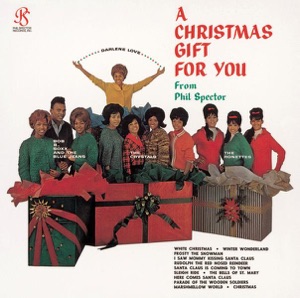
Rock / Early rock and roll · 1963
A Christmas Gift for You from Phil Spector
Phil Spector
Why listen
Familiar seasonal songs become a meeting of distinct voices. Follow a singer’s phrasing through the crowded accompaniment.
Listen and read
Tracks · previews
English editorial edition
Album story
Listen to the change from Darlene Love on White Christmas to the Ronettes on Frosty the Snowman. Before treating the record as a continuous festive background, notice who is shaping each sentence. Phil Spector’s name dominates the title, but this is not an album of one singer. The pleasure comes partly from hearing different performers inhabit a recognisable production style.
Released in 1963, the programme brings together Love, the Ronettes, the Crystals, and Bob B. Soxx and the Blue Jeans. Jack Nitzsche’s arrangements help give the instrumental layers their collective weight. Wall of Sound is the familiar production label; a practical way to approach it is to ask whether you can still follow a small vocal gesture when the accompaniment seems to arrive as a single mass.
A shared setting, several personalities
Move between Sleigh Ride and Winter Wonderland with the voices in mind. Familiar titles can make listening feel automatic, yet a phrase ending or a brief pause may change the character of a song you thought you knew. Remember one such detail rather than trying to identify every instrument. The common sound gives you a setting in which differences can become clearer.
Something unfamiliar enters
Christmas (Baby Please Come Home) was the newly written song among the seasonal standards. In her later Recording Academy account, Love recalled long sessions during the summer. The seasonal atmosphere was a studio construction, not a document of winter weather. Try asking when an unfamiliar melody begins to feel at home beside the familiar ones.
Separate the dates of recognition
The official site’s 2013 retrospective reports an initial number thirteen placing on Billboard’s dedicated Christmas album chart, not the general album chart. The Grammy Hall of Fame induction came in 1999. The linked digital edition contains thirteen tracks and carries a 2009 rights date; that does not make these new performances from 2009. Follow the sequence through Silent Night, then return to the opening voices with their differences in mind.
The album through its tracks
Compare the opening two singers, then listen to track eleven, Christmas (Baby Please Come Home).
Christmas (Baby Please Come Home)
Follow Love’s voice through the accompaniment rather than counting the layers behind her. Where does a phrase gather pressure, and where does it leave room for another entrance? Her later Recording Academy account identifies this as the album’s only newly written song and recalls the uncertainty of introducing it among established material. Use that history as a question about listening: when does a new melody begin to feel familiar? On a second hearing, follow what the accompaniment does while the voice pauses. The change of attention may make the same recording feel differently crowded. A preview can introduce a striking passage, but its position in the complete song gives that moment its proportions.
Reference · Recording Academy: Darlene Love firsthand recollection, 2014; Hall of Fame 1999Sleigh Ride
The Ronettes perform the fifth track in this edition. Put the title’s scenery aside for a moment and follow the relationship between a vocal sentence and the sounds beneath it. Then reverse your attention, keeping the accompaniment central while the voice passes through. A familiar tune can make its next movement seem inevitable; listening to phrase endings helps reopen that expectation. Hear it after the Crystals’ preceding track and compare how the two groups occupy a shared production setting. No ranking is required. A difference in vocal presence offers a reason to return when the seasonal setting no longer feels relevant. Recall the change between the first two tracks as another point of comparison.
Reference · Apple Music: thirteen-track 2009 rights edition
Listen next
Continue with A Date with the Everly Brothers to compare another relationship between overlapping voices and instrumental weight.
A Date with the Everly Brothers ↗References & editorial note
Written for English readers. Album facts are referenced below; listening suggestions are editorial interpretations. AI-assisted editorial review; not independently human-reviewed.