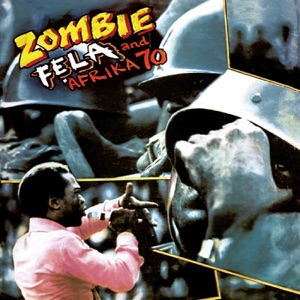
Reggae / Latin / Afrobeat & West Africa · 1976
Zombie
Fela Kuti
Why listen
Let the repeating movement catch your body before following the voice. Dance and satire occupy the same time, without requiring either to cancel the other.
Listen and read
Tracks · previews
English editorial edition
Album story
On Zombie, do not spend the instrumental opening only waiting for the singer. Follow a low repeated figure, then redirect your attention to a short horn entrance. The passage can remain familiar while your listening position changes. Fela Kuti’s music need not arrive as a political lecture you must understand before responding. Begin with movement; when the voice enters, ask what attitude it adds to the time the band has already made.
The catalogue uses 1976, while the official page pairs 1976 with 1977. Apple also displays a 1977 date alongside a 1976 rights notice. Keep that discrepancy visible rather than treating one field as a precise release history. The linked four-track edition adds recordings after Zombie and Mr. Follow Follow. Its closing Mistake is labelled as a 1978 Berlin performance. Those four selections should not be presented as one original programme recorded together.
Start with Tony Allen’s drums
Apple’s note points to Tony Allen’s overlapping drum rhythms and Fela’s saxophone on Zombie. Tap a steady beat, then follow the smaller drum movements around it: repetition need not mean everyone striking together. Does the drumming recede when the saxophone catches your attention? Move to the bass and percussion of Mr. Follow Follow afterwards. Its more subdued atmosphere gives the original pair a contrast beyond their shared criticism of obedience.
Keep the history specific
The title song satirises unquestioning military obedience. The official account connects the album with the violent 1977 attack on Kalakuta. That context concerns a particular Nigerian political situation, not a general character assigned to an entire continent. It helps explain the stakes without making every musical gesture an illustration of an event. Listen for the relationship between an inviting rhythm and an abrasive address.
Do not leave the answering voices behind
After the lead statement, attend to the reply. An answer from several voices can give a phrase a different weight from a solitary declaration. Even without understanding every word, you can follow the anticipation between them. Begin with the two original selections before exploring the additions. A short preview cannot represent the full relationship between an extended opening and what follows; a complete track is a useful next step.
The album through its tracks
Compare Zombie and Mr. Follow Follow. The four-track reference includes additional recordings, with a 1978 live performance explicitly identified at the end.
Zombie
When the voice appears to imitate a command, consider whether the reply sounds compliant or mocking. The official account identifies unquestioning soldiers as the satire’s target. That establishes a direction without requiring an extended lyric quotation. Yet reducing the performance to its argument would leave the band’s sense of time behind. Follow the pulse before and after the singing begins: does a spoken attitude change how the same movement feels? Listen once for a short horn gesture, then for the interval before an answering voice. A serious subject need not forbid the pleasure of movement. Holding those responses together can be more revealing than deciding in advance that this must be either protest or dance music.
Reference · Fela Kuti official: Zombie (1976/1977), historical note and reissue programmeMr. Follow Follow
Follow the bass and percussion after the title track. Apple’s note describes a darker, reflective atmosphere: does the repeating low movement make the same attention to obedience feel less boisterous? This is the second selection on Apple’s four-track reference, before the added recordings, and belongs to the original pair. Let the title become a question about surrendering judgment rather than a label to apply automatically to someone else. Follow the low movement first, then return to what continues while the voice rests. Does the music retain its force without words? Staying beyond the famous title song gives you two extended experiences to compare, rather than one slogan standing in for an entire album.
Reference · Apple Music: Zombie, four-track expanded edition
Listen next
Continue with King Sunny Adé’s Juju Music and compare another Nigerian setting for guitars, interlocking movement and several voices. Shared geography need not imply an identical musical approach.
Juju Music ↗References & editorial note
Written for English readers. Album facts are referenced below; listening suggestions are editorial interpretations. AI-assisted editorial review; not independently human-reviewed.