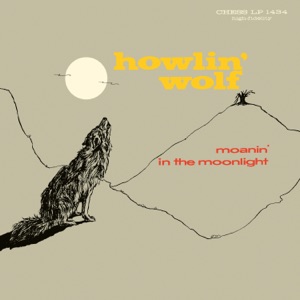
Blues / Chicago electric blues · 1959
Moanin' in the Moonlight
Howlin' Wolf
Why listen
A huge voice becomes more revealing when you listen to the small spaces the band leaves around it.
Listen and read
Tracks · previews
English editorial edition
Album story
Howlin’ Wolf can fill the frame with a single rough note, but the fascination is in what happens around it. A short instrumental reply suddenly acquires weight; a held vocal sound seems to stretch the beat. Moanin’ in the Moonlight rewards attention to that exchange, beyond the familiar description of an intimidating singer.
Issued by Chess in 1959, this first LP collected recordings made across several years. It was not a newly recorded twelve-song session. Early Memphis work with Sam Phillips sits beside recordings made after Wolf moved to Chicago. Debut here means a first album collection, not the beginning of his recording career, and one fixed band lineup cannot explain the entire programme.
Power needs room
Try following the instruments only when a vocal phrase ends. Their brief replies and persistent patterns give the voice something to push against. Then reverse the experiment and follow the changing weight of a sustained note. Loudness is only part of the effect: the alternation between a crowded foreground and a suddenly exposed accompaniment can feel just as forceful. You do not need specialist blues vocabulary to notice how a phrase changes the apparent size of the room.
An album of changing relationships
The opening Moanin’ at Midnight and How Many More Years establish the density of the early recordings. Smokestack Lightnin’ then makes a compact recurring figure an especially clear reference for the voice. Rather than inventing a continuous narrative or treating the sequence as a chronology, compare how each short performance redistributes attention. Continue beyond the familiar titles, through Evil (Is Going On) to Somebody in My Home, listening for the accompaniment to change the setting around a recognisable vocal presence.
Which record are we hearing?
UMe’s 2018 reissue account distinguishes three Memphis recordings from nine later Chicago selections; that is retrospective documentation, not a contemporary review. The linked Geffen digital edition carries the twelve-song programme, without a claim that its mastering matches the separately advertised vinyl reissue. Nor need the album be heard only as a source for later rock musicians. The breaths, rough edges and waiting spaces offer their own immediate reasons to return. Start with the performances before using their subsequent reputation to explain them.
The album through its tracks
Follow the instrumental replies at the ends of the vocal phrases.
Moanin' at Midnight
Before concentrating on words, follow the low vocal resonance and the sounds that rise above it. Register and texture establish a scene before any sentence is understood. This is one of the early Memphis recordings made with Sam Phillips. Its rough surface need not be heard solely as a technical limitation: the short repeating accompaniment and the longer vocal gestures create different measures of time. Count a recurring instrumental figure first, then notice where the voice stretches beyond it. Breath becomes part of the structure. The similar but distinct album and song titles are worth separating when searching for this opening performance.
Reference · uDiscover / UMe: 2018 reissue and recording historySmokestack Lightnin'
The returning instrumental figure gives you a stable reference for the voice’s movement. Because the accompaniment does not construct an entirely new scene each time, a small vocal inflection can loom larger. Follow that recurring line inwardly, then attend to the ends of the longer sounds above it and the tension that remains after they stop. This is track three in the linked twelve-song edition, changing the focus after the opening pair of early recordings. Set aside the shapes and lengths of later interpretations. Within this performance, a few persistent materials make room for remarkably different degrees of pressure and release.
Reference · Apple Music: twelve-track Geffen edition
Listen next
Otis Rush’s The Cobra Recordings offers another Chicago blues setting: compare the vocal entrances and phrase endings.
The Cobra Recordings ↗References & editorial note
Written for English readers. Album facts are referenced below; listening suggestions are editorial interpretations. AI-assisted editorial review; not independently human-reviewed.