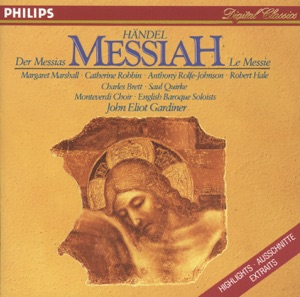
Classical / Baroque · 1982
Handel: Messiah
John Eliot Gardiner
헨델: 메시아 · 존 엘리엇 가디너
Why listen
Gardiner’s 1982 recording offers a path through Messiah by following the changing scale of solo and choral speech.
Listen and read
Tracks · previews
English editorial edition
Album story
One voice gives a phrase its shape; a chorus enlarges the space around it. If Messiah chiefly means Hallelujah to you, begin with these changes of scale in John Eliot Gardiner’s recording. The work contains speech-like movement and prolonged reflection as well as the collective force of its best-known chorus.
Handel composed the music, while Charles Jennens assembled the scriptural text. Gardiner conducts the English Baroque Soloists and Monteverdi Choir in this November 1982 London recording, carrying a 1983 phonogram date. Its soloists include Margaret Marshall, Catherine Robbin, Charles Brett, Anthony Rolfe Johnson, Robert Hale and boy soprano Saul Quirke. Composition, performance and release metadata describe different events; the service’s 1969 date does not fit this documented recording.
Allow reflection its own weight
Waiting only for famous choruses can make a slow solo seem like an interval between events. He Was Despised changes that perspective: the time one singer sustains alters the impact of the chorus that follows. Hallelujah is not the final movement. It closes Part II, after which further solo and choral music leads towards Worthy Is the Lamb and the concluding Amen.
Follow forms of address
Messiah is an English oratorio rather than an opera driven by a fixed cast exchanging dialogue. Scriptural passages move between solo and collective delivery. A recitative follows the inflections of speech; an aria allows a melodic idea more room; a chorus gives several lines a shared task. Recognising those differences supplies a route through the work without requiring every word to be mastered before listening.
Hear neighbours together
The linked programme occupies fifty-one tracks across two discs. Track divisions do not correspond mechanically to score numbers, and this edition should not be confused with highlights or a different release adding alternative arias. If a complete sitting feels too large, pair a solo with the next chorus. The useful discovery is not simply that a famous work is impressive. It is how one sustained voice and many voices speaking together produce different measures of time.
The album through its tracks
Hear the chorus following He Was Despised, then continue beyond Hallelujah into Part III.
Messiah: 21. Air: "He Was Despised"
Attend to how long Catherine Robbin allows a phrase to remain present. Slowness matters less as a number than as the wait between one vocal statement and the next. This Part II aria places a solo voice at the centre; its emotional setting should not be treated as a report of the singer’s private feelings. Follow the ends of the phrases first, then the strings moving or leaving space around them. A long movement does not require a new melody at every turn. Returning material may register differently after what intervenes. Continue into the next chorus to hear how this extended solo breathing belongs within the larger sequence, rather than treating it as an isolated lament.
Reference · AppleMusic:Gardiner51track programme,serviceyear error notedMessiah: 42. Chorus: "Hallelujah"
After the initial impression of collective strength, distinguish the passages in which the voices move together from those in which entries follow one another. These are different ways of assembling a chorus, and the change alters the tension even before you consider sheer volume. Here the Monteverdi Choir and English Baroque Soloists perform under Gardiner; the movement closes Part II, not the entire oratorio. Keep the next solo in your listening sequence. A single voice returning after this large choral statement restores a sense of distance that an isolated excerpt cannot provide. The familiar climax becomes an opportunity to hear sound gather into a block and separate into moving lines, rather than simply a cue to stop.
Reference · AppleMusic:Gardiner51track programme,serviceyear error noted
Listen next
Compare the division of time between solos and chorus with Bach’s B minor Mass.
Bach: Mass in B minor ↗References & editorial note
Written for English readers. Album facts are referenced below; listening suggestions are editorial interpretations. AI-assisted editorial review; not independently human-reviewed.
- BnF Philips4342972:November 1982London recording,1983phonogram,cast · catalogue.bnf.fr
- AppleMusic:Gardiner51track programme,serviceyear error noted · music.apple.com
- BostonBaroque/MartinPearlman:Messiah text anddramatic structure,not thisperformance · baroque.boston
- FoundlingMuseum:1742Messiah wordbook,Jennens text attribution · foundling.soutron.net