Jazz / Bebop · 1953
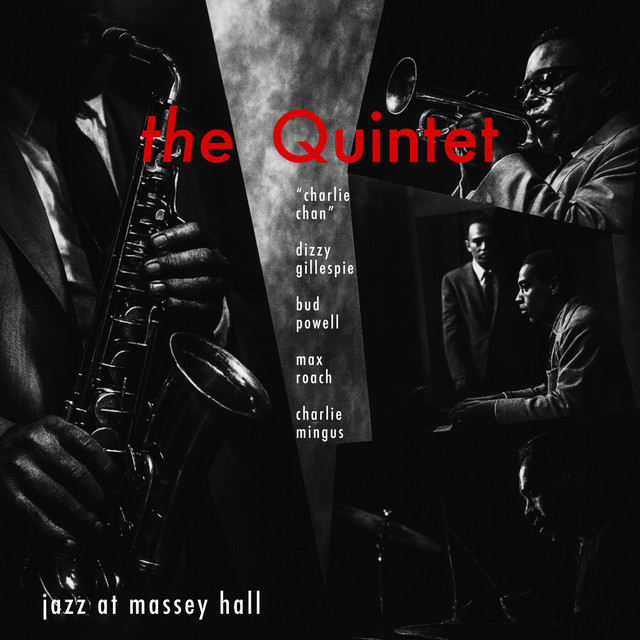
Jazz at Massey Hall
The Quintet
Why listen
Hear the supporting instruments redirect a solo without taking its place in the foreground.
Listen and read
Tracks · previews
English editorial edition
Album story
Try listening to a horn solo while keeping one ear on the piano or drums. The foreground line may race ahead, but the music around it keeps making decisions. This is the attraction of Jazz at Massey Hall: five celebrated players become audible as people responding to one another, rather than as names on an impressive cover.
The performance took place in Toronto on 15 May 1953. Charlie Parker plays alto saxophone, Dizzy Gillespie trumpet, Bud Powell piano, Charles Mingus bass and Max Roach drums. The concert and initial ten-inch issues belong to 1953; the familiar six-selection twelve-inch compilation followed in 1956. The linked Concord digital edition follows that compact programme, rather than presenting every performance from the evening.
A solo is still collective music
Perdido provides an approachable starting shape. Follow its melody, then notice what continues when an individual player moves forward. Solo does not mean that everyone else becomes irrelevant. A brief piano response or a shift in drum emphasis can alter how a phrase lands. There is no need to decode every rapid note: following the end of one statement and the beginning of its answer is enough to establish a route.
Different frames for the same five players
The clipped outline of Salt Peanuts offers a different point of entry from the unfolding All the Things You Are / 52nd Street Theme. Wee and Hot House lead towards A Night in Tunisia in the second half. Compare how much space each piece gives to a shared tune and to individual invention. The personnel remain constant while the shape of the conversation changes.
The concert became a record
Mingus added bass overdubs after the concert for the familiar album; later releases also made material without those additions available. Live therefore does not automatically mean an untouched document. Nor should the restoration specifications of the 2023 complete collection be assigned to this edition. Set grand retrospective claims aside and listen for an exchange you can actually follow. The musicians’ smallest responses make a more useful introduction than a ranking of historic concerts.
The album through its tracks
Replay one horn solo while following the piano, then the drums, to hear how accompaniment shapes its movement.
Salt Peanuts (Live)
The compact melodic shape gives the ear something to recognise amid rapid movement. Keep that outline in mind rather than trying to retain every note. This is the second selection in the quintet programme recorded at Massey Hall, not a later studio recreation. On a first pass, follow the horns when they state the tune together. On another, choose the piano or drums as an individual voice comes forward. Short accents can change the feeling of a continuing pulse without stopping its flow. Listen to the length of statements and responses, allowing speed to become part of a conversation rather than a measurement of technical prowess.
Reference · Universal Music Japan: session personnel and six-track LP sequenceAll the Things You Are / 52nd Street Theme (Live)
A spacious melodic frame and the movement towards a shared ending belong to one listening journey here. The linked edition groups both titles within a single track, reflecting their connection in the programme. Follow a horn line first, then turn towards the smaller piano gestures between phrases. When one soloist gives way to another, the continuing rhythm helps carry attention across the change. Near the end, notice how the focus of the group gathers again. A short preview may not include that transition, so distinguish the impression of an excerpt from the design of the whole performance. Both titles are useful signposts within the same track.
Reference · Craft Recordings: 2023 edition history, bass overdubs and original programme
Listen next
The Amazing Bud Powell Vol. 1 offers another setting in which to follow the pianist’s position within an ensemble.
The Amazing Bud Powell, Vol. 1 ↗References & editorial note
Written for English readers. Album facts are referenced below; listening suggestions are editorial interpretations. AI-assisted editorial review; not independently human-reviewed.
- Craft Recordings: 2023 edition history, bass overdubs and original programme · craftrecordings.com
- Concord: Original Jazz Classics Remasters context · concord.com
- Universal Music Japan: session personnel and six-track LP sequence · www.universal-music.co.jp
- Apple Music: six-track Concord digital edition · music.apple.com