Jazz / Bebop · 1954
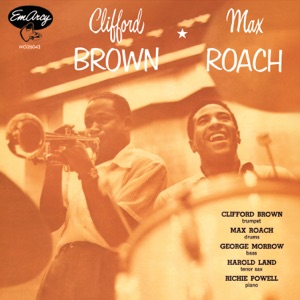
Clifford Brown and Max Roach
Clifford Brown & Max Roach
Why listen
Clear melodic shapes and flexible drum responses keep the music buoyant even when the lines move quickly.
Listen and read
Tracks · previews
English editorial edition
Album story
Start with the drummer while a horn is still playing. Max Roach’s small accents can change the weight of a phrase without taking the foreground away from Clifford Brown. This is a record of quick melodic thinking, but speed is only one of its pleasures: the five players continually offer different places to rest your attention.
Brown’s trumpet and Roach’s drums are joined by Harold Land on tenor saxophone, Richie Powell on piano and George Morrow on bass. Five Los Angeles recordings from 1954 formed the original ten-inch release. Two New York recordings from 1955 expanded it into the familiar seven-selection twelve-inch album. This reference follows that later programme; the shared title does not mean everything comes from one session.
Hear the drums without waiting for a solo
Daahoud and Joy Spring are useful starting points for hearing Roach within the ensemble. Notice the difference between a continuing pulse and a brief accent that seems to answer the horn. A drummer need not become louder to affect a phrase. Try returning to one small passage with Brown’s trumpet as your focus, then with the drums. The melody stays recognisable while its rhythmic surroundings become more distinct.
Keep a melody in your ear
Delilah and Parisian Thoroughfare offer shapes worth remembering before the solos begin. Once a player moves forward, those shapes remain a possible point of return. Listen to the interval between statements as well as differences in trumpet and tenor tone. Piano, bass and drums continue to shape the stride beneath each soloist. The two names on the cover introduce a five-person conversation.
The version is part of the route
Jordu is an edited performance of roughly four minutes and four seconds in the linked seven-track edition, which closes with What Am I Here For? Longer versions and alternate takes appear on expanded releases and should be kept distinct. Once that boundary is clear, return to the music rather than its reputation. You need not explain every note: following a different player through a familiar passage is enough to reveal another part of the group’s balance.
The album through its tracks
Remember a horn phrase, then replay it while following the cymbal pulse and the shorter drum accents.
Daahoud
A small melodic shape can provide an anchor even when the line moves rapidly. Follow the trumpet and tenor outline first, then listen below it to the drums. This piece belonged to the initial five recordings from 1954 and occupies fourth place in the linked seven-track programme. Keep it separate from the alternate take offered on expanded editions. Distinguishing the continuing pulse from intervening accents prevents the music from becoming one undifferentiated rush. Choose the end of a single statement rather than trying to remember every note. The attraction lies in melodic clarity and rhythmic flexibility operating together, with another player available to follow on each return.
Reference · Universal Music Japan: quintet personnel and seven-track core with edited JorduJoy Spring
If the melody suggests lightness, ask whether that feeling comes only from its upward movement or also from the spacing beneath it. This is another of the original five selections, placed fifth in the linked programme. An alternate take on expanded issues is a different performance of the piece and should not be silently substituted. Follow Brown’s statement once, then choose the smaller piano and drum gestures around it. The accompaniment does not simply repeat one answer while the melody advances. Compare crowded moments with brief openings to make the buoyancy more tangible. Let the title invite a response without dictating exactly what you must feel.
Reference · Universal Music Japan: quintet personnel and seven-track core with edited Jordu
Listen next
Jazz at Massey Hall offers another ensemble in which to follow Roach responding to different horns and piano.
Jazz at Massey Hall ↗References & editorial note
Written for English readers. Album facts are referenced below; listening suggestions are editorial interpretations. AI-assisted editorial review; not independently human-reviewed.
- Universal Music Japan: quintet personnel and seven-track core with edited Jordu · www.universal-music.co.jp
- Yamaha Music Connect: original five-track and expanded seven-track history · member.jp.yamaha.com
- Apple Music: seven-track Verve edition · music.apple.com
- Jazz Discography Project: Max Roach session and issue history · www.jazzdisco.org