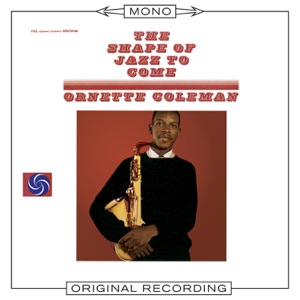
Jazz / Free jazz & avant-garde · 1959
The Shape of Jazz to Come
Ornette Coleman
Why listen
A pianoless quartet opens different relationships between melody and rhythm without erasing the identity of a tune.
Listen and read
Tracks · previews
English editorial edition
Album story
Calling The Shape of Jazz to Come an album without harmony turns a change in musical relationships into a slogan. There is no piano, but that does not mean that notes cease to relate to one another. Ornette Coleman’s alto, Don Cherry’s cornet, Charlie Haden’s bass and Billy Higgins’s drums make six distinct pieces. The useful question is what those four instruments can do together.
Recorded in Los Angeles on May 22, 1959, this was Coleman’s Atlantic debut. Lonely Woman provides the famous entrance, but Peace, third in the sequence, is the longest performance at roughly nine minutes. Reputation and duration do not assign the same weight to each track. The album becomes more tangible when its provocative title is accompanied by attention to the six actual pieces and their proportions.
More than one sense of speed
In his Library of Congress essay, Stephen Rush describes the contrast between Lonely Woman’s plaintive melody and its fast-moving drum feel. That observation supplies a useful starting point: the character of one layer need not describe every other layer. A melody can suggest lingering while the rhythm remains active. Calling the whole performance slow or fast captures only part of that relationship.
A long piece before the midpoint turns
Eventually leads into Peace; Focus on Sanity then opens the remaining group of three, followed by Congeniality and Chronology. The greatest individual span is not reserved for a concluding statement. The six performances distribute their weight differently, even with the same quartet throughout. Their order matters as well as the best-known theme, giving each piece a position within a larger shape.
Absence is not disorder
Without piano, the horns can still establish melodic directions, the bass can shape movement through its register, and the drums can articulate time. No single instrument needs to supply a complete answer in advance. The quartet invites attention to the relationships those roles create. Its future-facing title becomes a practical question about playing together, rather than a demand that listeners accept a historical slogan before hearing a tune.
The album through its tracks
Keep the melody and rhythmic motion of Lonely Woman distinct, then notice the space Peace receives as the third performance.
Lonely Woman
The opening performance lasts about five minutes. Rush’s analysis points to the plaintive melody over a much quicker rhythmic feel, suggesting a way of approaching the piece without giving every instrument the same emotional or temporal label. A line can seem to linger while the drums remain active beneath it. Listening need not become a search for which layer has the one true speed. Their coexistence offers an entry into the tension of the whole performance. Continuing into the shorter Eventually also helps keep the famous opener in proportion: it introduces one particular relationship within an album that still has five other compositions and several different spans to explore.
Reference · Stephen Rush / Library of Congress — original analysis of the album and its tonal referencesPeace
At roughly nine minutes and five seconds, the third track has the album’s largest individual span. It is more substantial than a brief pause suggested by its peaceful title. Rush draws attention to Haden’s bowed bass here, a reminder that the lowest instrument need not remain a purely supporting presence. A different method of sounding the strings can change what a listener notices within a familiar quartet. Peace is also far from the end: Focus on Sanity, Congeniality and Chronology remain. Hearing it as one spacious scene rather than the record’s final resolution leaves room for those later performances to develop the album beyond this particular point of repose.
Reference · Stephen Rush / Library of Congress — original analysis of the album and its tonal references
Listen next
Continue with Free Jazz to compare six pieces for four players with the expanded scale and sustained collective performance of a double quartet.
Free Jazz ↗References & editorial note
Written for English readers. Album facts are referenced below; listening suggestions are editorial interpretations. AI-assisted editorial review; not independently human-reviewed.
- Rhino — original six-track programme, quartet and May 22, 1959 session · www.rhino.com
- Stephen Rush / Library of Congress — original analysis of the album and its tonal references · www.loc.gov
- Qobuz / Rhino Atlantic — six LP versions with 2005 rights and full credits · www.qobuz.com
- Apple Music — complete six-track 2005 Atlantic remaster · music.apple.com
- Rhino — distinct mono reissue · www.rhino.com