Film music / Jazz in film scores · 1959
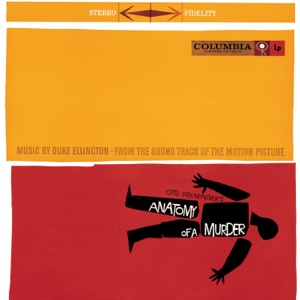
Anatomy of a Murder
Duke Ellington
Anatomy of a Murder · 듀크 엘링턴
Why listen
Brief orchestral replies and individual horn colours turn film music into a lively conversation on record.
Listen and read
Tracks · previews
English editorial edition
Album story
A murder title does not require an uninterrupted atmosphere of darkness. Duke Ellington’s orchestra moves between tension, wit and ease through short phrases and sharply differentiated instrumental voices. Before trying to reconstruct a film scene, listen for who speaks and who answers inside the band.
Ellington and Billy Strayhorn created the music for Otto Preminger’s 1959 courtroom drama. No knowledge of the verdict is needed to enter the album. Nor are its titles a script to be decoded: the record offers its own sequence of compact pieces, with contrasts that can work independently of the images.
A large band can make small gestures
Big band does not mean everyone playing loudly at once. An individual voice briefly steps forward, a section replies, or the texture leaves only a few sounds exposed. Compare the outline of the opening number with Flirtibird and notice how the apparent space changes. Even without remembering a whole tune, you can follow a rough edge, a sustained note or a sharply clipped response. Hearing such colours as characters is a useful imaginative approach, but it need not become a claim that every solo represents one particular person in the story.
The soundtrack album is a separate route
Jack Sohmer’s 1999 JazzTimes review explains that film and LP selected different performances. The album therefore should not be treated as an exact running order of what appears on screen. Here, a piece acquires meaning partly through the next piece. Compare the suggestive titles Midnight Indigo and Sunswept Sunday, but check the actual rhythm and texture instead of allowing the words to dictate everything you hear. Continue to Upper and Outest: a succession of compact settings becomes a portrait of the orchestra’s range.
Recognition and later expansion
A Grammy nomination certificate preserved by the Smithsonian documents contemporary recognition, and its catalogue records the Dance Band performance award. The music was being heard as orchestral performance as well as film scoring. This edition follows the original thirteen-track Columbia programme, distinct from the twenty-five-track expansion. Start with that concise sequence before exploring additional material. Repeated themes in alternative performances are illuminating later, but the original album first establishes the different voices and balances that make comparison meaningful.
The album through its tracks
Compare the foreground line with the section replying beneath it, then follow the change into Flirtibird.
Main Title and Anatomy of a Murder
Begin by separating the phrase that springs forward from the instruments responding behind it. If the orchestra initially sounds like one large block, that simple division makes its movement easier to follow. Notice moments when a reply seems to arrive before the preceding thought has completely settled. The title may suggest suspense, but the rhythmic appeal belongs to the body too. You can hear both qualities without knowing the scene. Remember the clearest line on one pass, then attend to what happens during its rests. This introduces the album as an arrangement of contrasting musical personalities, not merely a condensed account of a plot.
Reference · Apple Music: original thirteen-track Columbia programmeFlirtibird
After the opening number, concentrate on how a note is lengthened and shaped rather than trying to hold the entire orchestral outline in mind. The title suggests flirtation, but does not require a definitive judgment about a film character. A flowing line and the smaller responses underneath it create their own sense of distance. Repeated notes can change their manner through the force of their beginnings and endings. Follow the accompaniment as well as the exposed voice: its restraint makes room for expression. Without images, those relationships can become particularly clear. Returning to the first track afterwards reveals how an intimate gesture can emerge within a large band.
Reference · Apple Music: original thirteen-track Columbia programme
Listen next
Compare Miles Davis’s Ascenseur pour l’échafaud for another relationship between jazz performance, screen tension and independent album listening.
Ascenseur pour l'échafaud ↗References & editorial note
Written for English readers. Album facts are referenced below; listening suggestions are editorial interpretations. AI-assisted editorial review; not independently human-reviewed.
- Smithsonian: Ellington and Strayhorn soundtrack manuscripts · avpreservation.si.edu
- Smithsonian: contemporary Grammy nomination certificate and award · americanhistory.si.edu
- Jack Sohmer, JazzTimes: 1999 expanded edition review · www.jazztimes.com
- Jimmy Stewart on the Air: original LP labels and programme · www.jimmystewartontheair.com
- Apple Music: original thirteen-track Columbia programme · music.apple.com
- Apple Music: expanded twenty-five-track edition for comparison · music.apple.com