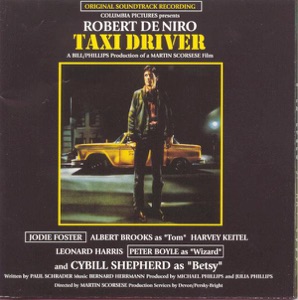
Film music / New Hollywood · 1976
Taxi Driver
Bernard Herrmann
Taxi Driver · 버나드 허먼
Why listen
A seductive saxophone theme collides with orchestral pressure, making the viewpoint of the film unstable rather than merely illustrating its city.
Listen and read
Tracks · previews
English editorial edition
Album story
Taxi Driver offers two incompatible invitations: follow the saxophone, or attend to the weight gathering around it. Bernard Herrmann makes the distance between those invitations central to the score. Its appeal extends well beyond an evocative tune for a night drive.
Recorded in late 1975 for the 1976 film, this was Herrmann’s final film score. The linked Arista programme follows the eighteen tracks of the expanded edition, rather than reproducing the original LP sequence. Tracks one through eleven present the film score; album versions and additional interpretations follow. Ronny Lang plays saxophone in the score, while Tom Scott plays on the later arrangements conducted by David Blume. Their shared thematic material does not make these interchangeable performances.
Pressure around the melody
The melodic writing and the darker orchestral figures behave differently. One encourages a listener to follow a sustained line; the other makes recurring shapes and instrumental mass difficult to ignore. Harp and drums contribute to the transitions between them. Calling the whole record jazz would obscure this argument between materials. On a return of the saxophone theme, notice what the preceding passage has done to your expectations: the same attractive melody need not offer the same reassurance.
Several cues inside one track
The extended titles of tracks five and seven advertise a construction from multiple scene cues. These are useful listening maps, not homework in remembering the plot. Look for changes of material instead of expecting each long track to develop like a single song. The pairing of the assassination attempt and its aftermath in track ten similarly directs attention beyond a dramatic peak toward what surrounds it.
Where the score ends
The music’s force does not require endorsement of Travis Bickle’s violence. Its contrasting materials permit distance from his view. Stop initially after track eleven to register the score’s trajectory. The spoken component of Diary of a Taxi Driver then changes how explicitly the album frames its music. Blume’s later interpretations offer another setting for the themes, useful for comparison without pretending that the entire disc represents one continuous film performance.
The album through its tracks
Hear tracks 1–11 first, then compare the album versions at 12–13 and additional arrangements at 14–18.
Taxi Driver (Main Title)
This opening is a compact introduction to the score’s divided materials. Attend to the orchestral setting as well as the saxophone melody: their different weights prevent the cue from settling into a single comfortable mood. Lang is the soloist here, distinct from Scott on the additional arrangements later in the programme. If the theme already feels familiar, shift attention to the passages immediately surrounding it. That comparison is more useful than treating the entire cue as a romantic city portrait. Returning here after the second selection can also change what seems prominent: the lyrical line becomes one component of an unsettled construction, rather than the album’s complete message.
Reference · mfiles: score and additional interpretations personnelThe .44 Magnum Is a Monster
The sixth track offers a counterweight to the famous saxophone theme. Approach its weapon reference as dramatic context, not an invitation to admire violence. The useful comparison concerns pressure: how recurring material and instrumental weight affect the listener differently from a long melodic line. It helps explain why the score cannot be adequately represented by its attractive main theme alone. Continue into the following collection of cues to place this piece within a changing dramatic sequence. Heard that way, it becomes more than an isolated exercise in menace. No claim about a character’s diagnosis is needed to describe the difference between musical attraction and the uncomfortable force that surrounds it.
Reference · mfiles: score and additional interpretations personnel
Listen next
Compare Chinatown for another relationship between a solo wind instrument and the orchestral construction of an urban film.
Chinatown ↗References & editorial note
Written for English readers. Album facts are referenced below; listening suggestions are editorial interpretations. AI-assisted editorial review; not independently human-reviewed.