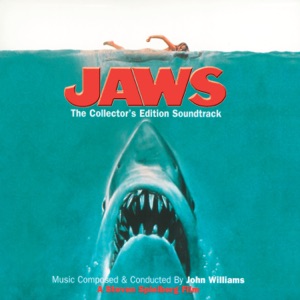
Film music / Symphonic blockbuster scores · 1975
Jaws
John Williams
Jaws · 존 윌리엄스
Why listen
A compact orchestral album reveals how a tiny threatening motif can coexist with a much broader language of maritime adventure.
Listen and read
Tracks · previews
English editorial edition
Album story
The shark has two famous notes, but Jaws has considerably more music. John Williams builds an album in which menace and forward motion do different jobs. The pleasure lies in discovering how a listener’s memory of that tiny motif changes the livelier passages around it.
This entry follows the original twelve-track album associated with the 1975 film. Williams conducted a separate album recording in April, after the film-score sessions in March. It is therefore an original album performance, not a later conductor’s reconstruction or an uninterrupted extraction from the film. The linked Geffen programme is distinguished from the 2025 remix and from the complete film score; identical mastering is not claimed.
A small unit with large consequences
Start by noticing what happens after recognition. The opening figure can change its pressure through pace, repetition and orchestral weight without requiring an entirely new melody. Chrissie’s Death follows the main title and establishes danger early. Yet the album does not require every subsequent piece to remain inside that same narrow emotional frame. The remembered threat becomes a reference point against which other kinds of movement register.
Adventure has its own momentum
Promenade and Out to Sea widen the setting before the longer Sea Attack Number One. One Barrel Chase then gives pursuit a more buoyant physical character. Calling every energetic passage another expression of fear would flatten these distinctions. Try the sixth and seventh tracks together: a large confrontation followed by a chase makes a different musical sequence from two interchangeable statements of danger. The contrast matters even without matching each passage to a remembered shot.
An album beyond the scene list
Preparing the Cage and Night Search subsequently offer preparation and exploration rather than continuous pursuit. Listen for the redistribution of momentum between these pieces before reaching the end title. The programme works as an arrangement of orchestral spans, with different lengths and functions, as well as a reminder of a film. On a second pass, the quieter transitions may explain its shape more clearly than another isolated replay of the famous opening.
The album through its tracks
Compare the main title with track seven, then follow the change from pursuit into preparation and night exploration.
Main Title (Theme from "Jaws")
This is the roughly two-minute-twenty-one-second album opener, rather than the short film opening cue. Once the familiar figure has registered, follow its changing pace and orchestral weight. Recognition is almost immediate; the organisation of pressure takes longer. A small repeated idea can imply approach without presenting a fresh tune at every turn. Consider where that pressure gathers, and where a change of scale interrupts your expectation. Then let Chrissie’s Death follow instead of replaying the famous introduction. The transition encourages a distinction between an opening statement that identifies the album and a subsequent piece that gives danger a more particular dramatic shape.
Reference · Jaws official anniversary: original album recordingOne Barrel Chase
The seventh track makes a useful corrective to the idea that Jaws is exclusively music of lurking terror. Hear it after the much longer Sea Attack Number One, and compare the movement of pursuit with the scale of confrontation. Briskness alone does not describe the difference: recurring accents and the way short phrases propel their successors also matter. You need not identify the exact film shots to follow that physical momentum. Continue into Preparing the Cage and notice how the programme changes its allocation of energy again. These three adjacent tracks provide a practical route into the album’s construction beyond its instantly recognisable title motif.
Reference · Intrada: original album programme and separate anniversary restoration
Listen next
Planet of the Apes offers a contrasting orchestral strategy, building unfamiliar textures where Jaws often transforms a readily remembered motif.
Planet of the Apes ↗References & editorial note
Written for English readers. Album facts are referenced below; listening suggestions are editorial interpretations. AI-assisted editorial review; not independently human-reviewed.