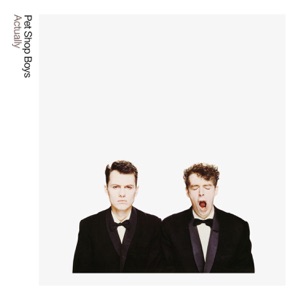
Pop / Synth-pop & New Romantic · 1987
Actually
Pet Shop Boys
Why listen
A duet’s changing perspectives and a theatrical statement of guilt share the same polished dance-pop space.
Listen and read
Tracks · previews
English editorial edition
Album story
Dusty Springfield’s arrival is an especially revealing moment on Actually. Another vocal grain answers Neil Tennant’s measured delivery, and a precise electronic backing becomes a place occupied by two different people. Elsewhere, It’s a Sin expands the scale towards theatrical declaration. The album has room for both kinds of drama: a change in conversational weight and a much larger gesture.
Pet Shop Boys’ official catalogue dates their second studio album to 7 September 1987. Its production involved several collaborators, and the listening reference here is the original ten-track programme in the 2018 remaster. Further Listening’s demos and remixes belong outside that sequence. Always on My Mind, although associated with the same period, is not one of these ten original album tracks.
Words of exchange
What Have I Done to Deserve This? is followed by Shopping and Rent. Those titles do not supply a single compulsory meaning, but their proximity invites attention to the language of exchange alongside personal relationships. Does a buoyant rhythm lighten a statement, or make its discomfort more apparent? Tennant need not push a phrase hard for its question to remain present. The pleasure of the melody can coexist with uncertainty about the stance of the voice.
Changing the size of the room
The passage from It Couldn’t Happen Here into It’s a Sin makes scale particularly audible. The latter has a personal context: Tennant’s official account connects it to his Catholic schooling. Keep that attribution specific rather than treating one recollection as everyone’s religious experience. Musically, follow what the surrounding arrangement adds when the singer remains in the same register. Drama can increase through density and recurrence as well as through the height of a note.
A different final impression
I Want to Wake Up and Heart lead towards King’s Cross, which lets the programme finish with a different afterimage from its largest chorus. Hear the sequence’s changes of distance without forcing every song into a completed plot. The lasting attraction is not a hidden serious message that requires the dancing surface to be discarded. It is the possibility of hearing pleasure and unresolved feeling at once, with neither being asked to cancel the other.
The album through its tracks
Compare the duet’s shifts of voice with the larger-scale transition into It’s a Sin.
What Have I Done to Deserve This?
Listen for a change in the weight of a sentence when Springfield and Tennant exchange the foreground. The beat continues, but their deliveries do not have to agree in texture or emphasis. The official archive confirms the duet and explains that the intended collaboration had not been arranged in time for Please. Here it appears as the second album track, separate from extended and disco mixes. Begin with the difference between the voices, then compare where each finishes a phrase. Does the more expansive delivery carry all the emotion, or does restraint exert a different kind of pressure? The song gains dimension by preserving those differences rather than smoothing them into one anonymous voice.
Reference · Pet Shop Boys: Dusty Springfield duet historyIt’s a Sin
When the refrain opens out, distinguish the singer’s contribution from the accumulating pressure of the backing. Repeated rhythm and instrumental density help create the scale; vocal height is only one element. Tennant’s stated connection to his Catholic schooling gives the theme of guilt a specific personal starting point, not a universal explanation of religious education. This is track seven in the album programme, following the broader breath of It Couldn’t Happen Here. Follow the boundary into the refrain on one pass, then hear what continues when the voice briefly retreats. The album version also has a place in a larger sequence, which a separate disco mix need not preserve in the same way.
Reference · Pet Shop Boys: It’s a Sin, Tennant’s account
Listen next
Return to Please to compare how the duo expanded vocal relationships and dramatic scale on their second studio album.
Please ↗References & editorial note
Written for English readers. Album facts are referenced below; listening suggestions are editorial interpretations. AI-assisted editorial review; not independently human-reviewed.
- Pet Shop Boys: Actually original programme · www.petshopboys.co.uk
- Pet Shop Boys: 2018 reissue credits and bonus boundaries · www.petshopboys.co.uk
- Pet Shop Boys: Dusty Springfield duet history · www.petshopboys.co.uk
- Pet Shop Boys: It’s a Sin, Tennant’s account · www.petshopboys.co.uk
- Apple Music: Actually ten-track 2018 remaster · music.apple.com