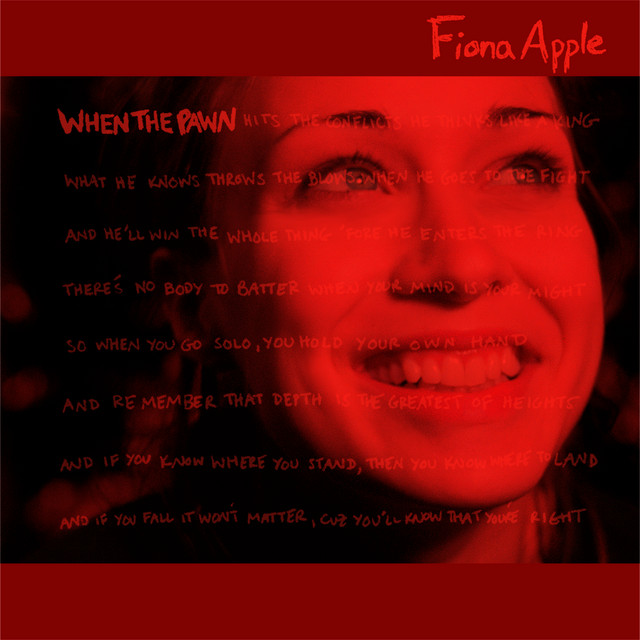
Pop / Art pop · 1999
When the Pawn…
Fiona Apple
Why listen
Piano movement and extended vocal phrases meet percussion, horns and strings in arrangements that give each song a different shape.
Listen and read
Tracks · previews
English editorial edition
Album story
When the Pawn… is famous for its unusually long full title, yet the album itself contains ten carefully placed songs. The motion of On the Bound directs attention towards piano and rhythm before any title puzzle. Paper Bag’s buoyant setting and the turns inside Fast As You Can belong to the same writer. Calling the record emotionally intense does not explain those different designs.
Released in 1999, Fiona Apple’s second album was produced by Jon Brion, with Apple writing all ten songs. In a contemporary EQ interview, Brion described asking for initial piano and vocal recordings, using a click where appropriate. That starting point matters: elaborate production does not mean the basic songs arrived empty of musical ideas. Hear the relationship between their movement and the additional arrangement.
An animated setting can complicate a sentence
Paper Bag follows Love Ridden. The former’s horns and lighter movement need not determine the feeling of every sung line. Listen in turn to the piano’s pulse, the placement of instrumental responses and the length of a vocal phrase. Identifying every instrument is less important than noticing which element moves forward at a particular moment.
Speed is not one continuous condition
Fast As You Can invites an expectation of uninterrupted haste. Instead, follow how its urgent passages relate to sections with a different breadth. You need not know numerical time signatures to notice that a pulse feels different under the body. On another listen, ask whether the change first registers through piano, drums or singing. Many turns do not automatically make a song disconnected.
The ninth song does not have the last word
Get Gone gives way to I Know. Treating the earlier track’s force as the album’s sole conclusion can make the final song seem unnecessary. Allow that ending a different stance, and the sequence becomes more than a simple escalation of anger. Musical decisiveness and hesitation can coexist without turning the singer into a personality diagnosis. Return to the opening afterwards and compare the forms of momentum.
The album through its tracks
Move from Love Ridden to Paper Bag, follow the internal turns of Fast As You Can, and continue beyond Get Gone into I Know.
Paper Bag
The fifth track lasts approximately three minutes and thirty-nine seconds. Horns help animate its arrangement, but that apparent brightness need not settle the emotion of every phrase. Follow the piano’s pulse and instrumental responses first, then notice where Apple cuts a sentence short or lets it continue. Even without immediately translating every word, the singing and arrangement need not seem to move with identical expressions. Place Love Ridden before it and A Mistake afterwards to hear its position as a transition. A familiar video can provide an association, but the selection is the original album recording. Compare whether instruments reinforce a phrase together or briefly suggest different directions around it.
Reference · Qobuz Clean Slate/Epic: album versions, full durations and creditsFast As You Can
Select the seventh track’s approximately four-minute-thirty-eight-second album version, preserving the time its changes require rather than substituting another single or live recording. Begin by finding what your body follows in the faster sections, without trying to label every metre numerically. When another kind of passage arrives, ask whether the extended vocal phrasing and piano movement change together. Drums and percussion do more than maintain a speed: emphasis can alter the experience of equal spans of time. Rather than treating every turn as a complete restart, remember what carries forward from the preceding material. Returns as well as departures help give this substantial pop song its overall form.
Reference · Qobuz Clean Slate/Epic: album versions, full durations and credits
Listen next
Continue with Sinéad O’Connor’s I Do Not Want What I Haven’t Got, comparing how forceful singing takes different shapes through the arrangements of individual songs.
I Do Not Want What I Haven't Got ↗References & editorial note
Written for English readers. Album facts are referenced below; listening suggestions are editorial interpretations. AI-assisted editorial review; not independently human-reviewed.
- Sony Music Canada: official complete ten-title programme · shop.sonymusic.ca
- Qobuz Clean Slate/Epic: album versions, full durations and credits · www.qobuz.com
- EQ December 1999: Jon Brion describes piano/vocal starting tracks · www.worldradiohistory.com
- Apple Music: selected original ten-song programme · music.apple.com