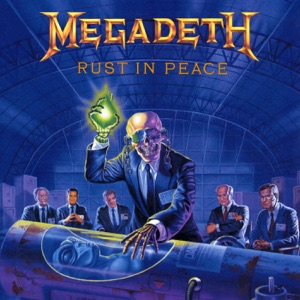
Rock / Hard rock & heavy metal · 1990
Rust in Peace
Megadeth
Why listen
Riffs, transitions and unequal song lengths make this a useful record for hearing thrash as arrangement rather than as an undifferentiated measure of speed.
Listen and read
Tracks · previews
English editorial edition
Album story
Fast is a starting observation, not a complete account of Rust in Peace. Speed feels different when a song keeps driving the same material and when it turns into another section. Begin with the proportions: an opener lasting more than six minutes shares this nine-track programme with Dawn Patrol, which lasts less than two. Musical intricacy can be heard through placement and connection as well as through the number of notes.
Megadeth’s fourth album, released in 1990, was their first with Marty Friedman and Nick Menza. The selected digital issue contains nine tracks and carries Capitol’s 1990 copyright. It is distinct from the separately identified 2004 Remix / Expanded Edition. This edition choice does not prove complete identity to an original pressing master. Keeping distribution and composition apart helps prevent production differences from being mistaken for changes inherent to a song.
Listen across the joins
The extended opening track invites attention to how one passage gives way to another. Waiting only for a solo can obscure the riffs that establish its setting. Hear the vocal sections and instrumental foreground separately, then restore their connection. Enjoying instrumental skill does not require abandoning an interest in the route taken by the whole song.
Keep the band around the guitars
Friedman’s arrival matters, but knowing his name does not require guessing the player of every guitar phrase. Mustaine’s contribution and the rhythmic organisation remain part of the picture. When the guitars become busy, consider what bass and drums are doing underneath. The state of the music before and after a solo can be as useful a landmark as the solo itself.
A short track before the finish
Dawn Patrol precedes Rust in Peace... Polaris. Removing the shortest piece as if it were an empty interval would alter that approach to the ending. After the expansive opening, a compact unit near the close changes the album’s proportions. Individual tracks can stand alone, but the order in which their different lengths are encountered belongs to the experience of hearing all nine together.
The album through its tracks
Follow connections between sections in the opening two tracks, then notice the short Dawn Patrol before the final song.
Holy Wars... The Punishment Due
Hear the long opener as a sequence of changing passages rather than reducing it to a verdict on speed. When material changes, consider whether the earlier momentum continues or another kind of tension takes over. Vocal sections and instrumental foreground can also exchange responsibilities. A solo heard in isolation offers one experience; restored to its surrounding riffs, it raises questions about placement. There is no requirement to name every subdivision or identify every guitarist immediately. Noticing where a change of direction occurs can already provide a route through the piece. This selection opens the nine-track studio programme, distinct from an early demo or the later live performances of the album.
Reference · Apple Music: nine-track1990 Capitol distributionHangar 18
The second track keeps guitar playing central without making the rest of the band irrelevant. Notice how a foreground line joins the rhythmic material beneath it, and what survives as the next passage begins. Moving through several sections can make a fast performance feel like more than an accumulation of notes. Compare its development with the preceding Holy Wars... The Punishment Due: adjacent songs by the same band need not follow one identical design. Rather than assigning every passage to Friedman or Mustaine by guesswork, concentrate on the connections themselves. Those observations can provide specific questions if you later consult performance material, instead of beginning with an unsupported list of solo attributions.
Reference · Apple Music: nine-track1990 Capitol distribution
Listen next
Continue with Guns N’ Roses’ Appetite for Destruction, comparing how two guitar-centred bands place longer and shorter songs across an album.
Appetite for Destruction ↗References & editorial note
Written for English readers. Album facts are referenced below; listening suggestions are editorial interpretations. AI-assisted editorial review; not independently human-reviewed.