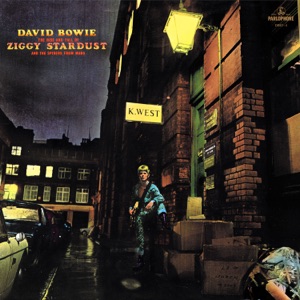
Rock / Glam & art rock · 1972
The Rise and Fall of Ziggy Stardust
David Bowie
Why listen
Eleven songs build their own drama through proportion and instrumental contrast, alongside the force of the Ziggy persona.
Listen and read
Tracks · previews
English editorial edition
Album story
Even before the character is explained, the album has a distinctive entrance and exit. Five Years opens at length; Rock ’n’ Roll Suicide ends the programme in under three minutes. Between them, the expansive Moonage Daydream and compact Hang on to Yourself occupy very different spaces. Setting the costumes aside for a moment reveals how sequence and arrangement make a stage of their own.
Bowie and Ken Scott produced the 1972 album, with Mick Ronson, Trevor Bolder and Mick Woodmansey forming its central band. Electric guitar supplies a prominent outline, but it is not the whole texture. Scott later described bright acoustic guitar as helping fill the upper register. The forward instrumental figure and the continuing accompaniment perform different jobs within what initially feels like one unified band sound.
Songs before a finished script
Scott recalled that Starman entered the programme after the label requested a single, replacing a planned Chuck Berry cover, Around and Around. The recollection makes the sequence a set of practical choices, rather than proof that every detail followed an immutable initial script. The subsequent stage character and listeners’ narrative connections matter without requiring every song to have been conceived as a consecutive scene.
Two sides, different proportions
The first side contains five tracks, ending with It Ain’t Easy. Ron Davies wrote that song, the sole composition here without Bowie’s writing credit. Lady Stardust begins a six-song second side. More tracks do not necessarily mean more time: a run of compact songs changes the proportions. The relationship between number and duration is part of the album’s construction.
The name arrives late
Ziggy Stardust appears ninth, with Suffragette City and Rock ’n’ Roll Suicide still to follow. The title song is neither an introduction nor a final explanation. Coming after the shortest track, it establishes one centre within the latter sequence. Forceful motion then gives way to a brief ending. The record’s drama emerges through these changes, rather than through a continuous increase in scale.
The album through its tracks
Compare Starman’s broad refrain with the recurring guitar outline of Ziggy Stardust, then continue through the final two tracks.
Starman
The fourth song occupies approximately four minutes fourteen seconds between Moonage Daydream and It Ain’t Easy. Compared with the compact passages later on, it has considerable room for its melodic invitation. Scott’s recollection of its late addition provides useful context: an important place in a finished album need not have been planned from the outset. Follow how the verse prepares the wider refrain, then consider how that familiar melody sits between its neighbours. The selection is the studio album track, distinct from a television performance or another single mix. Hearing it within the eleven-song order lets its independent musical movement coexist with memories of the performer’s famous public image.
Reference · Guitar Player: Ken Scott interviewed about the album’s construction and guitar soundZiggy Stardust
The title track makes a recurring guitar outline central to its identity. Ronson’s figure remains easy to follow, while Bowie’s vocal phrases occupy the spaces around it in changing ways. The interaction matters as much as remembering the instrumental shape by itself. At approximately three minutes fourteen seconds, this ninth track follows the shorter Hang on to Yourself and leaves two further songs to complete the programme. Its position therefore offers a centre within the second side rather than a final account of everything the album contains. The selected recording is the studio performance in its 2012 remaster, keeping the original arrangement distinct from demos and the different proportions of live renditions.
Reference · Qobuz / Parlophone: complete eleven-song programme and credits
Listen next
Return to Hunky Dory to compare piano-led writing and varied song lengths across these two consecutive albums.
Hunky Dory ↗References & editorial note
Written for English readers. Album facts are referenced below; listening suggestions are editorial interpretations. AI-assisted editorial review; not independently human-reviewed.
- David Bowie official: original eleven-song album and producers · www.davidbowie.com
- Guitar Player: Ken Scott interviewed about the album’s construction and guitar sound · www.guitarplayer.com
- Rhino: original sequence, 2012 remaster and direct Apple link · www.rhino.com
- Qobuz / Parlophone: complete eleven-song programme and credits · www.qobuz.com
- Apple Music US: eleven-song 2012 remaster delivery · music.apple.com