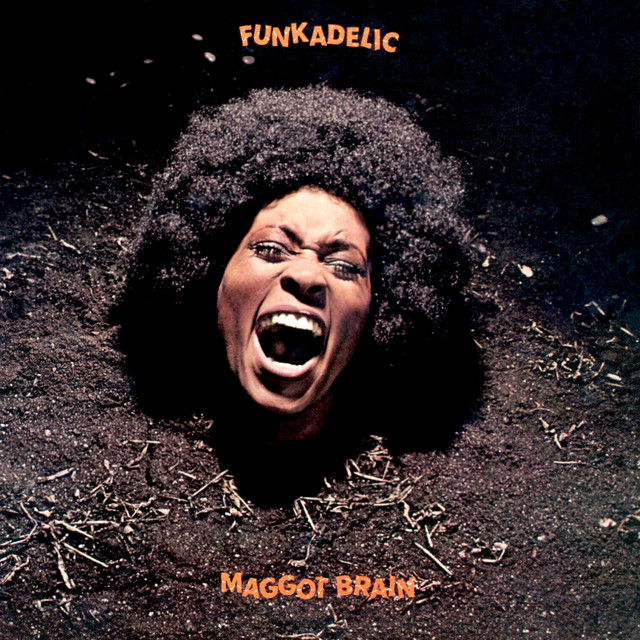
Soul / R&B / Funk · 1971
Maggot Brain
Funkadelic
Why listen
An extended guitar monologue gives way to a concise chorus, revealing more than one emotional scale.
Listen and read
Tracks · previews
English editorial edition
Album story
Maggot Brain opens with over ten minutes of guitar, then changes size abruptly through the under-three-minute Can You Get to That. Eddie Hazel’s sustained, bending line occupies space like an individual voice before a group of singing voices opens another entrance. The title performance’s fame can obscure the rest, but the sharp connection between those first tracks is itself a reason to hear Funkadelic’s whole album.
This edition contains all seven songs of the 1971 programme. George Clinton’s official site recounts asking Hazel to imagine an intensely sad situation for the title performance. That story should not become a claim that the guitarist recorded after receiving news of an actual family death. It offers context for how an instrument carries a long expressive line, without fixing one required response. Alternate mixes and live performances do not replace the selected opener.
The first room belongs to the guitar
Attend less to the number of notes than to the time a bent tone remains. After the spoken entrance, the guitar directs attention towards the next pitch and duration instead of a returning sung refrain. Held sounds and quicker passages give the same instrument contrasting tones of address. Heard beyond a display of technique, the spaces between sounds become part of its phrasing too.
The shorter songs open another route
Can You Get to That brings multiple voices and a compact song form forward. Hit It and Quit It and You and Your Folks, Me and My Folks occupy the centre without merely serving as rests around larger performances. Short phrases gathering into a chorus reveal another face of the group. Listening beyond the first pair makes the placement of voices more useful than deciding where rock ends and soul begins.
The ending is not a duplicate
Super Stupid and the brief Back in Our Minds lead to the extended Wars of Armageddon. Long pieces at both ends do not promise identical experiences. Attention concentrated on a guitar at the start can face a denser sound space at the finish. The shorter songs connect those different scales. Completing the sequence returns the celebrated solo to its role as a dramatic opening rather than a monument standing outside the record.
The album through its tracks
Play Maggot Brain directly into Can You Get to That and hear the change from a long guitar line to concise collective singing.
Maggot Brain
The title recording lasts about ten minutes nineteen seconds here. Follow a sustained guitar tone and hear how a bend or tremor changes its apparent inflection. The request to imagine sadness, recounted on the official site, supplies context rather than an instruction to feel only one emotion. It should not be mistaken for confirmation of an actual family death at the session. Instead of counting every quick note, notice how a held sound makes you anticipate the next movement. The spoken opening and the guitar communicate through different means. Continue directly into Can You Get to That so the long monologue’s position within the album becomes clearer.
Reference · George Clinton official: Eddie Hazel and the title performanceCan You Get to That
The second track lasts about two minutes fifty seconds, a substantial change of scale after the opener. An ear occupied by one long guitar line now meets several singing voices and compact phrases. Compare whether that transition lightens the preceding weight or opens a different possibility alongside it. Attend to high and low voices and the spacing between them when a refrain gathers. Elaborate genre terminology is not needed to hear the contrast between an extended instrumental address and a collective sung phrase. Give the short song its complete shape rather than treating it as an appendix. Continue into Hit It and Quit It to follow another turn in that smaller format.
Reference · Westbound official Bandcamp: 1971 album, full seven-track sequence and lengths
Listen next
Compare Sly and the Family Stone’s There’s a Riot Goin’ On for another 1971 organisation of guitar, voices and recorded space within funk.
There's a Riot Goin' On ↗References & editorial note
Written for English readers. Album facts are referenced below; listening suggestions are editorial interpretations. AI-assisted editorial review; not independently human-reviewed.
- George Clinton official: Eddie Hazel and the title performance · georgeclinton.com
- Westbound official Bandcamp: 1971 album, full seven-track sequence and lengths · funkadelic.bandcamp.com
- Westbound Records: original programme versus 2026 reissue · westboundrecords.com
- Apple Music: complete seven-track edition · music.apple.com