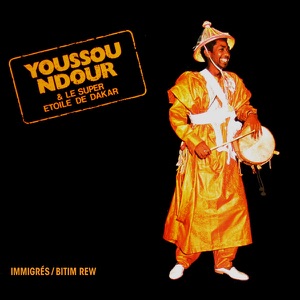
Reggae / Latin / Afrobeat & West Africa · 1984
Immigrés
Youssou N'Dour
Why listen
Four extended songs give the voice and percussion of a Dakar dance band room to shape distinct scenes.
Listen and read
Tracks · previews
English editorial edition
Album story
Youssou N’Dour and Le Super Étoile de Dakar fill approximately thirty-four minutes with just four tracks on Immigrés. The title brings migration and connections with home into view, but the music is not confined to quiet reflection. A high, expansive voice meets active percussion, guitar, horns and keyboards. Learning the term mbalax can provide context; hearing how those sounds address one another provides an immediate entrance.
Immigrés / Bitim Rew opens, followed by Pitche Mi, the extended Taaw and the shorter closing Badou. A contemporary Talking Drums review from June 1984 documents this same four-track programme. The digital edition’s 1988 date belongs to the later reissue history. These are the album selections rather than later concert versions or a collection of short singles. Hearing the first pair and the second pair separately makes their differing proportions easier to grasp.
Percussion as a conversational presence
Sabar and tama percussion contribute more than a marker beneath the song. Short, sharply shaped sounds answer or cross a vocal phrase while bass and keyboards keep the ensemble connected. Unfamiliar accents need not be described as impossible for a Western listener to understand. Begin with one recurring figure, then notice where another sound meets it. Two interacting parts can offer a clearer route than trying to count everything simultaneously.
The length of a phrase, not only its height
N’Dour’s upper register creates a striking first impression. Equally important is the change from a sustained phrase to a shorter statement. Pitche Mi gives the singing room to unfold before Taaw extends the ensemble’s movement on a larger scale. Voice and percussion are not rival attractions; their different kinds of articulation make the song’s shape more audible.
A smaller final frame
In this edition Taaw approaches twelve minutes, while Badou lasts about five and a half. The finale therefore changes scale after the broadest performance. Nor must every title repeat the opening song’s subject. The four selections show a band adjusting its gestures to different songs, rather than stating one message four times. That range is part of the album’s invitation.
The album through its tracks
Start with the exchange between voice and percussion in the opener, then compare the proportions of Taaw and the closing Badou.
Immigrés / Bitim Rew
The seven-minute opener places the connection between migrants and home at the entrance to the album. Afrisson describes the song as encouraging emigrants to retain a relationship with their country. That account need not be expanded into a line-by-line translation or a rule about every migrant’s experience. In the arrangement, the voice’s long reach and the percussion’s brief replies offer different kinds of address. The drums do not become mere scenery when the singer rises. Remember the beginning and ending of one vocal phrase, then hear the smaller sounds passing between them. The social subject and the energy of a dance ensemble can remain part of the same encounter.
Reference · Afrisson — Immigrés / Bitim rew programme and creditsBadou
After the longest performance, Badou closes the album in approximately five minutes and thirty-five seconds, the shortest of its four selections. That change of scale matters: it does not simply repeat the preceding track’s dimensions. The contemporary 1984 review also compared Taaw and Badou as neighbouring performances, drawing attention to the band’s colour and emphasis. Carry your impression of the previous song into this one. Rather than ranking it as the most complicated percussion track, notice how an instrumental accent meets the arrival of the voice. You need not isolate every drum to hear the relationship. One vocal phrase and one short response can reveal how the finale gathers its energy.
Reference · Talking Drums, 25 June 1984 — contemporary review of Celluloid CEL6709
Listen next
Pirates Choice by Orchestra Baobab offers another Dakar dance-band approach, with a different emphasis on extended guitar and saxophone exchanges.
Soro ↗References & editorial note
Written for English readers. Album facts are referenced below; listening suggestions are editorial interpretations. AI-assisted editorial review; not independently human-reviewed.
- Talking Drums, 25 June 1984 — contemporary review of Celluloid CEL6709 · talkingdrumsmagazine.com
- Afrisson — Immigrés / Bitim rew programme and credits · www.afrisson.com
- Trouser Press — 1984 Celluloid and 1988 Earthworks editions · trouserpress.com
- Apple Music — complete four-track Immigrés · music.apple.com