Reggae / Latin / Other African traditions · 2004
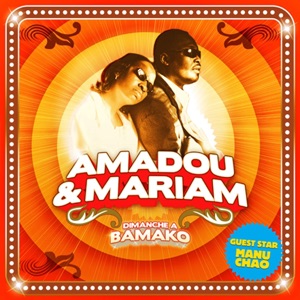
Dimanche à Bamako
Amadou & Mariam
Why listen
Three appearances of M’bifé frame an album that places celebration beside social concerns.
Listen and read
Tracks · previews
English editorial edition
Album story
Dimanche à Bamako begins with two short M’bifé tracks and eventually returns to M’bifé blues. Between those points, weddings, movement, peace and politics enter the programme. Amadou and Mariam’s singing and guitar meet Manu Chao’s production in an album whose private and public subjects share the same space.
The duo had worked for years before this collaboration. Chao’s prominent involvement should not erase the musical partnership already in place. Mariam introduces M’bifé, the following track foregrounds balafon, and the closing blues returns to the same name on a larger scale. Those positions give the fifteen tracks a frame beyond their individual hits. Sénégal Fast Food and Beaux dimanches are effective introductions, but neither alone explains the way the programme returns to its opening material after moving through a variety of urban and personal scenes.
Two entrances and a return
M’bifé lasts a little over two minutes, followed immediately by the shorter M’bifé balafon. The instrumental designation marks a change within a shared title. At the other end, M’bifé blues extends to more than five minutes. Comparing those three placements reveals how recurrence contributes to the album’s shape without requiring every intervening track to belong to one continuous narrative.
Celebration has neighbours
Beaux dimanches depicts Sunday weddings in Bamako. It is followed by La paix, while La réalité and Politic amagni occupy other parts of the record. Social concerns and festive scenes therefore coexist within the running order. The wedding song offers an accessible entrance to the album, but it does not turn the whole programme into a picture of uninterrupted leisure.
Collaboration with different roles
Chao contributes production and appears vocally on Sénégal Fast Food, among other selections. Beaux dimanches, however, is written by Amadou Bagayoko. These distinct credits matter: collaboration does not mean that one participant authors everything. Conversations and surrounding sounds also enter the production, which assembles performances and atmosphere rather than preserving one continuous live event. The duo’s musical centre remains essential to the result.
The album through its tracks
Connect the opening M’bifé pair with the final blues, then hear La paix after the wedding song.
Sénégal Fast Food
The fifth track is a prominent collaboration featuring Manu Chao’s voice. This selection uses the original album performance, approximately four minutes and nineteen seconds long. It sits between La réalité and Artistiya, well beyond the brief opening M’bifé pair. Its prominence need not turn the entire record into a Chao solo project: the guest appears within an album built around Amadou and Mariam. Comparing this song with Beaux dimanches makes the range of collaborative roles more concrete. It also introduces another scene within a programme that includes Taxi Bamako later on. The title alone should not be treated as sufficient evidence for a detailed account of a particular person’s journey.
Reference · MusicBrainz — disc-specific performance creditsBeaux dimanches
Amadou Bagayoko wrote this song about Sunday weddings in Bamako, with production by Manu Chao. The original ninth track lasts approximately three minutes and thirty-one seconds and directly evokes the album title. Its celebration is particularly useful when heard with its neighbour, La paix, and the later Politic amagni. The festive gathering belongs to a broader programme of everyday and social concerns. This selection preserves the original album version rather than a shorter compilation edit. Paired with Sénégal Fast Food, it also distinguishes a song written by Amadou from a conspicuous guest collaboration. Both provide entrances to the album, whose final M’bifé blues still awaits beyond them.
Reference · Ultratop — Beaux dimanches writer and producer credits
Listen next
Compare Konono N°1’s Congotronics for a different instrumental and production approach to urban music-making.
Congotronics ↗References & editorial note
Written for English readers. Album facts are referenced below; listening suggestions are editorial interpretations. AI-assisted editorial review; not independently human-reviewed.
- Amadou & Mariam — official Bandcamp original fifteen-track edition · amadoumariam.bandcamp.com
- Because Music — official retrospective biography, original 2004 release · press.because.tv
- RFI — contemporary album account · www1.rfi.fr
- Ultratop — Beaux dimanches writer and producer credits · www.ultratop.be
- MusicBrainz — disc-specific performance credits · musicbrainz.org
- Apple Music — original fifteen-song programme · music.apple.com
- Amazon Music — licensed Beaux Dimanches text · music.amazon.fr