Classical / Classical era · 1982
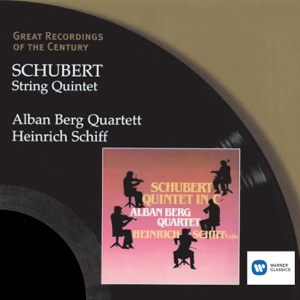
Schubert: String Quintet in C
Alban Berg Quartett / Heinrich Schiff
슈베르트: 현악 5중주 C장조 · 알반 베르크 콰르텟 / 하인리히 쉬프
Why listen
A second cello enlarges the possible combinations of melody, sustained harmony and pizzicato, rather than simply making a quartet darker.
Listen and read
Tracks · previews
English editorial edition
Album story
Two cellos do more than increase the weight at the bottom of Schubert’s String Quintet. One can support while the other sings, or they can share a melodic passage. Elsewhere, sustained inner parts coexist with shorter gestures at the edges of the ensemble. Hearing these different combinations turns the work from a long atmosphere into a sequence of specific relationships among five players.
The Alban Berg Quartet and Heinrich Schiff recorded the complete four-movement work in 1982. This current Warner delivery lasts about forty-seven minutes thirty-three seconds; its opening movement is just under fifteen minutes. The composition dates from 1828, a separate chronology from the performance. Two violins, one viola and two cellos are present throughout, with no piano. The celebrated Adagio belongs inside that complete instrumental and formal setting.
An extra instrument creates options
When the cellos share a melody in the first movement, the added player does not merely duplicate a supporting function. Their combination changes where the melodic centre can sit. Transfer attention from the upper strings towards those two lower voices, then hear what the remaining instruments contribute around them. Ensemble size becomes an arrangement choice, not simply a way of increasing loudness or depth.
Separate layers within the Adagio
Its opening combines a sustained line in the middle of the texture with first-violin gestures and second-cello pizzicato. These simultaneous activities make stillness an incomplete description. The contrasting middle section and subsequent return provide a larger design, but the opening already contains decisions worth following. Hear both recognisable material and changed detail when the earlier character comes back.
The remaining movements alter the pace
The Scherzo and its slower Trio share one track in this edition, despite their contrasting movement. The finale then advances from Allegretto towards greater speed. Follow those later stages before defining the entire quintet through its slow movement. Warmth, weight and rhythmic drive coexist within the same instrumentation, and the famous Adagio acquires another perspective when restored to its neighbours.
The album through its tracks
Find the paired cello melody in the first movement, then distinguish the Adagio’s sustained inner parts from its shorter outer gestures.
String Quintet in C Major, D. 956: II. Adagio
The second movement lasts about fourteen minutes thirty seconds here. Its opening does not make all five instruments move slowly in the same way. A sustained inner line coexists with shorter violin gestures and plucked second-cello notes. Locate that pizzicato first, then compare its duration with the bowed sound above it. Waiting only for the dramatic middle section can conceal the activity already present in the quieter texture. When the earlier character returns, attend to both familiarity and altered detail. A brief preview cannot demonstrate the whole return. This selection is the second movement of the specified complete recording, not an independent arrangement or a separately recorded excerpt.
Reference · Hyperion — Schubert D956 work analysis by Misha DonatString Quintet in C Major, D. 956: I. Allegro ma non troppo
At approximately fourteen minutes thirty-nine seconds in this performance, the opening movement provides a concrete introduction to the additional cello. Hear the two cellos sharing a melody, then consider how the other strings support or respond around them. The enlarged ensemble matters even when it is not playing at maximum volume. Changes of harmonic colour also complicate any assumption that C major means one consistently bright mood. Keep this recording’s actual duration distinct from a general estimate based on other performances. Becoming familiar with the first movement’s distribution of melodic roles makes the following Adagio’s different relationships easier to hear as part of the same complete work.
Reference · Qobuz / Warner — four movements, performers, production and durations
Listen next
Return to the Budapest Quartet’s late Beethoven recordings to compare extended designs with only one cello, keeping composition dates separate from recording dates.
Beethoven: Late String Quartets ↗References & editorial note
Written for English readers. Album facts are referenced below; listening suggestions are editorial interpretations. AI-assisted editorial review; not independently human-reviewed.
- Warner Music Japan — 1982 recording and 2021 digital reissue · wmg.jp
- Warner Classics — official link to current Apple collection · www.warnerclassics.com
- Qobuz / Warner — four movements, performers, production and durations · www.qobuz.com
- Hyperion — Schubert D956 work analysis by Misha Donat · www.hyperion-records.co.uk
- CiNii — original EMI edition recording dates and venue · ci.nii.ac.jp
- Apple Music GB — current four-movement delivery · music.apple.com