Classical / Romantic · 1962
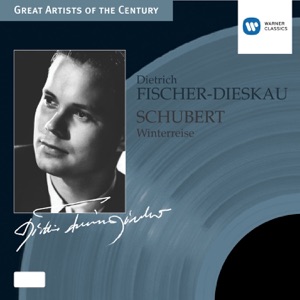
Schubert: Winterreise
Dietrich Fischer-Dieskau / Gerald Moore
슈베르트: 겨울나그네 · 디트리히 피셔디스카우 / 제럴드 무어
Why listen
Baritone and piano give a winter landscape changing meanings across twenty-four songs, from a walking departure to a troubling encounter with another musician.
Listen and read
Tracks · previews
English editorial edition
Album story
The singer does not take the first step alone in Winterreise. The piano establishes movement before the traveller begins to speak. Hearing Dietrich Fischer-Dieskau’s baritone together with Gerald Moore’s playing reveals more than twenty-four variations on sadness: memory, expectation and the surrounding landscape can pull against one another. What the voice hopes for and what the music subsequently establishes need not agree.
Schubert completed the cycle in two parts during 1827, setting poems by Wilhelm Müller. This is the EMI recording made by Fischer-Dieskau and Moore in Berlin in November 1962, preserved here in Warner’s delivery carrying 1963 and 2004 rights dates. Its complete twenty-four-song programme lasts about seventy-one minutes twenty-seven seconds. It must be distinguished from their 1955 recording and the singer’s later partnerships.
The piano interprets the landscape
Trees, rivers and birds are not merely invitations to add sound effects. A recurring figure can also represent how the traveller perceives his surroundings. The opening movement of Gute Nacht and the collision of dream and waking in Frühlingstraum do different dramatic work. When the voice stops and the keyboard continues, an instrumental ending can qualify what has just been said. Accompaniment is therefore an incomplete description of Moore’s task.
Not a steady emotional fade
The later songs still include the brief force of Der stürmische Morgen and the self-assertion of Mut! In this recording they last approximately fifty-two seconds and one minute twenty-four seconds. These compact episodes interrupt the proportions of longer songs. Treating the cycle as changing memories, dreams and responses is more useful than imagining a continuous plot or an emotion that simply drains away at a fixed rate.
Another musician at the end
Der Leiermann introduces a hurdy-gurdy player. The piano’s restricted repetition suggests a different kind of continuation from the opening walk. It need not be described as a complete absence of melody or a definitive statement of the traveller’s future. The encounter leaves room for interpretation. A full uninterrupted hearing is valuable, but learning the first and last songs before tracing their connections is also a legitimate way into this large work.
The album through its tracks
Compare the walking movement of Gute Nacht with the repetition of Der Leiermann, then trace changes between dreams and their interruption in the intervening songs.
Gute Nacht
The piano establishes a continuing motion before the baritone enters, but the emotional situation does not remain fixed simply because the accompaniment keeps moving. A temporary change of colour is answered by the instrumental ending’s return to the darker opening character, a contrast discussed in the Los Angeles Philharmonic’s programme note. This delivery lasts about five minutes twenty-two seconds. Rather than treating every moment as an identical footstep, consider what the vocal phrases do above that recurring motion. Moore’s continuation after the sung words belongs to the drama too. Remembering both the statement and its instrumental aftermath makes the passage into the next song more than a change of track.
Reference · Los Angeles Philharmonic — Herbert Glass on Winterreise structure and piano writingDer Leiermann
The musician encountered at the end does not arrive to explain the journey. Repetition and sustained tones evoke the hurdy-gurdy while the baritone addresses the situation from the traveller’s position. After so many changes of scene, the small amount of musical material becomes an event in itself. That sparseness need not mean that melody or feeling has vanished altogether. Compare these approximately three minutes twenty-eight seconds with the opening song: continuing to move and making progress are not necessarily the same experience. The cycle can end without a grand increase in volume. Piano and voice leave the encounter present rather than providing a spectacular summary of everything that preceded it.
Reference · Barbican — A Winter’s Journey, programme notes
Listen next
Wunderlich and Giesen’s Schumann Dichterliebe offers another relationship between poetry and the piano’s ending. Compare what the instrument can do after the sung words have stopped.
Schumann: Dichterliebe ↗References & editorial note
Written for English readers. Album facts are referenced below; listening suggestions are editorial interpretations. AI-assisted editorial review; not independently human-reviewed.
- Warner Music Japan — November 1962 recording, performers and complete programme · wmg.jp
- Apple Music — complete twenty-four-song Warner 1963/2004 delivery · music.apple.com
- Warner Classics — official 2025 collection linking the same 1963/2004 cycle · www.warnerclassics.com
- Qobuz / Warner — comparison programme, twenty-four songs and credits · www.qobuz.com
- Los Angeles Philharmonic — Herbert Glass on Winterreise structure and piano writing · www.laphil.com
- Barbican — A Winter’s Journey, programme notes · www.barbican.org.uk
- Bibliothèque nationale de France — original 1963 stereo publication · catalogue.bnf.fr