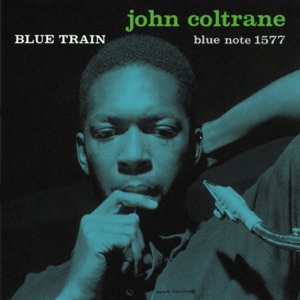
Jazz / Hard bop & Blue Note · 1957
Blue Train
John Coltrane
Why listen
A tenor-trumpet-trombone front line and changing solo order give the five performances distinct ensemble structures.
Listen and read
Tracks · previews
English editorial edition
Album story
Blue Train begins with something closer to a small horn choir than a lone saxophone’s greeting. John Coltrane’s tenor stands beside Lee Morgan’s trumpet and Curtis Fuller’s trombone. Their combined breadth establishes a point of departure that individual solos later reshape. The six-piece instrumentation is part of the album’s design, not merely a list of supporting names.
Recorded on September 15, 1957, at Van Gelder’s Hackensack studio, the session adds Kenny Drew on piano, Paul Chambers on bass and Philly Joe Jones on drums to the three horns. Four Coltrane originals surround one Kern-Mercer song, I’m Old Fashioned. Blue Note places release in 1957. The chosen programme consists of the five finished album tracks, excluding alternate takes and false starts. It should also be distinguished from the instrumentation of Coltrane’s celebrated later quartet.
A compact horn choir
The title theme and an extended solo occupy different dimensions. Hear the width of the combined horns against the direction taken by one instrument. The solos pass from Coltrane to Morgan to Fuller, changing timbre and articulation over a continuing blues foundation. A trombone filling the lower part of the ensemble, then taking the lead itself, gives this recording a texture different from a two-horn small group.
The first soloist is not always the leader
Coltrane takes the first substantial solo in Locomotion, whereas Morgan leads the solo sequence in Lazy Bird. The songs are not identical platforms awaiting the bandleader. Alongside Moment’s Notice, these quicker performances can be differentiated by who takes over after the theme. Drew, Chambers and Jones do not simply furnish an empty background: piano harmony, bass motion and drumming carry the long horn statements while preserving the ensemble’s character.
A different lineage in fourth position
I’m Old Fashioned is the sole composition not written by Coltrane. After three originals, a ballad places the band’s treatment of an existing song beside its own repertory. Calling it a rest because it is slower misses that programming decision. Lazy Bird then closes the album, completing a contrast that disappears when the ballad is isolated. Rather than treating Blue Train only as a preview of later experiments, encounter the finished design available within these five pieces and this particular six-person band.
The album through its tracks
Compare the title track’s Coltrane–Morgan–Fuller solo order with Morgan’s initial solo position in Lazy Bird.
Blue Train
The opening album performance lasts approximately ten minutes forty-three seconds. Remember the width of the three-horn theme so that the dimensions of a single leading instrument become clearer. Coltrane’s tenor gives way to Morgan’s trumpet and then Fuller’s trombone, a succession involving changes of colour as well as personnel. The continuing blues foundation supports different directions and registers. Do not reduce the theme to a memorable introductory tag; it establishes the ensemble setting capable of holding these extended solos. This is the main album performance, not alternate take seven or eight from an expanded edition. When the theme returns, consider the scale at which the six players reconvene after the individual statements.
Reference · Apple Music: selected five remastered studio tracksI'm Old Fashioned
The fourth track is a ballad lasting approximately seven minutes fifty-nine seconds, written by Jerome Kern and Johnny Mercer rather than Coltrane. Coming after Locomotion, its handling of a sustained song melody opens a different scene. Instead of counting how much embellishment follows the initial presentation, hear how the recognisable song remains available within the extended performance. Isolated, it can seem simply a gentle selection; in the album it is the only borrowed composition among four originals. Continue into Lazy Bird to preserve that programming decision. The movement returning after the ballad reveals both the breadth it has introduced and the character of the ending. Slower pace alone does not explain its position.
Reference · Apple Music: selected five remastered studio tracks
Listen next
Compare Saxophone Colossus: a quartet with one tenor gives themes and solos different proportions from this three-horn ensemble.
Saxophone Colossus ↗References & editorial note
Written for English readers. Album facts are referenced below; listening suggestions are editorial interpretations. AI-assisted editorial review; not independently human-reviewed.