Film music / Minimalism & contemporary composition · 1983
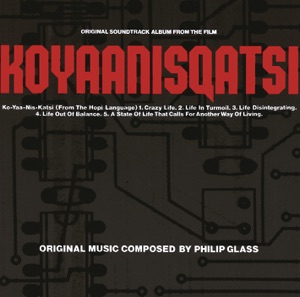
Koyaanisqatsi
Philip Glass
Koyaanisqatsi · 필립 글래스
Why listen
Low solo singing, interlocking patterns and an extended ensemble movement create sharply different experiences of musical time.
Listen and read
Tracks · previews
English editorial edition
Album story
The opening of Koyaanisqatsi gives considerable weight to a low solo voice and slowly moving harmony. By The Grid, the fifth track, the record has entered a much denser world of repeated figures. The contrast is larger than a switch from slow to fast. Glass makes the duration of a pattern, and the number of layers moving around it, part of the composition’s dramatic scale. Six tracks can therefore contain a substantial journey rather than six brief themes.
This is the original 1983 Antilles album of selections from Godfrey Reggio’s film, distinct from the composition’s 1982 date. Michael Riesman conducts; Glass and Kurt Munkacsi produced the recording. The six-part album makes its own programme from the film music. Glass later described the score’s origins in the keyboard, wind and vocal ensemble language he had already been developing for years.
Different kinds of vocal presence
Albert de Ruiter’s low solo in the title track is followed by Vessels, with the Western Wind Vocal Ensemble. Moving from a single dark register to several active parts changes how voices occupy the music. They can carry syllables and also function as a moving instrumental texture. The album therefore establishes contrasting vocal characters before reaching its largest ensemble span.
Music as a working partner
Reggio has described giving Glass visual material to respond to, rather than telling him what to compose. That account helps explain music which shapes the experience of a scene instead of merely confirming its mood. The move from Cloudscape to Pruit Igoe changes the pressure of the middle sequence through harmonic weight and rhythmic activity.
The long concluding movements
The Grid is the longest track in this original selection. Repeated figures gain force through their changing surroundings, making accumulated time part of the effect. Prophecies then takes roughly eight minutes to close the album and reconnect it with the darker vocal world of the beginning. Together, these two movements give the second half its broad proportions.
The album through its tracks
Compare the title track’s low solo with the extended accumulation in The Grid: repetition operates at very different scales in the two movements.
Koyaanisqatsi
The title track introduces the record through Albert de Ruiter’s low solo voice. At approximately three and a half minutes, it establishes a measured entrance rather than trying to compress the whole score into a miniature overture. Sustained harmony gives the repeated vocal gesture weight; repetition here need not imply speed. Its placement before Vessels is especially effective, since the next track changes the number and movement of the vocal parts. The opening can consequently be remembered as one distinctive register within a much larger palette. Returning to it after the closing Prophecies also changes its apparent function: what first felt like an introduction becomes one end of a wider frame.
Reference · Philip Glass: original 1983 Antilles six-track album and personnelThe Grid
The fifth track runs for about fourteen minutes and fifty-six seconds in this original album programme. That scale gives recurring figures room to interact with changes in density and emphasis. A pattern can remain recognisable while its role within the ensemble changes, so the accumulating time becomes part of the musical event. Pruit Igoe prepares this broad central span, and Prophecies provides its contrasting aftermath. The selected track is not the roughly twenty-one-minute version on later eight-track editions. Its length matters because the album allocates a substantial share of its playing time to this one movement, allowing repetition to build a form rather than simply decorate a short theme.
Reference · Philip Glass: original 1983 Antilles six-track album and personnel
Listen next
Continue with Daft Punk’s Tron: Legacy to compare another period’s combination of electronic repetition and large ensemble writing for film.
Tron: Legacy ↗References & editorial note
Written for English readers. Album facts are referenced below; listening suggestions are editorial interpretations. AI-assisted editorial review; not independently human-reviewed.
- Philip Glass: original 1983 Antilles six-track album and personnel · philipglass.com
- Philip Glass: own account of the trilogy’s instrumental development · philipglass.com
- Great Northern: Godfrey Reggio first-person interview on musical collaboration · thegreatnorthernfestival.com
- Philip Glass: separate 1998 eight-track new recording · philipglass.com
- Qobuz: licensed Island six-track delivery and timings · www.qobuz.com
- Apple Music US: selected original six-track delivery · music.apple.com
- Philip Glass: 1982 composition entry, distinct from album release · philipglass.com