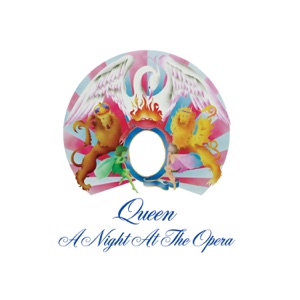
Rock / Hard rock & heavy metal · 1975
A Night at the Opera
Queen
Why listen
Four writers and sharply unequal song lengths make the album change scale as readily as it changes style.
Listen and read
Tracks · previews
English editorial edition
Album story
Knowing A Night at the Opera chiefly as the home of Bohemian Rhapsody can obscure the journey towards it. Before that eleventh track come miniature comedy, a car song, a folk excursion and another extended dramatic construction. The album repeatedly changes the size of its stage. Its variety matters because the smaller pieces alter how the large ones are encountered, rather than merely filling the space around a famous single.
Released in November 1975, the album features Freddie Mercury, Brian May, Roger Taylor and John Deacon, working with producer Roy Thomas Baker. Contributions from all four writers prevent a single personality from determining every turn. This selection follows the twelve-track programme confirmed by Queen’s official store. Deluxe additions are excluded, and God Save the Queen remains the final track. The current distribution is not identified here as an identical copy of any particular earlier master.
Four different approaches
Taylor’s I’m in Love with My Car and Deacon’s You’re My Best Friend place forceful rock and compact pop close together. May’s ’39 then opens a different kind of journey. Treating these songs as essential parts of the design challenges the idea that everything here simply supports Mercury’s grandest composition. Their contrasting proportions are already an argument about what this band can contain.
The usefulness of miniatures
Lazing on a Sunday Afternoon lasts barely more than a minute in the selected edition. Its brevity can feel like a quick change of scenery rather than an unfinished idea. Seaside Rendezvous and Good Company likewise loosen the grip of heavy rock. Against such modest dimensions, the length of The Prophet’s Song becomes a more conspicuous decision: expansion is one option among several.
Two large constructions
Compare the extended layering of The Prophet’s Song with the changes of musical form in Bohemian Rhapsody. Ballad, operatic theatre and hard rock establish successive expectations in the latter. The two pieces are ambitious in different ways. Continue beyond the familiar climax to the short final track; the album adds its own curtain after the celebrated song has completed its drama.
The album through its tracks
Compare the compact journey of ’39 with the changing forms of Bohemian Rhapsody, then continue through track twelve.
'39
Queen’s official account describes May’s composition as folk inspired by science fiction. That premise need not become a puzzle that must be solved before the song can work. Consider its position instead: after You’re My Best Friend and before Sweet Lady, it introduces another sort of movement into the sequence. The familiar shape of a folk song makes an intriguing partner for an unfamiliar journey. At roughly three and a half minutes, it also demonstrates how a change of scene need not require an epic duration. Comparing it with the album’s longer constructions helps separate musical scale from imaginative scope. Small dimensions can still make the surrounding record feel larger.
Reference · Queen official: original release, four writers and musical formsBohemian Rhapsody
The sequence of ballad, operatic ensemble and hard rock invites attention to transitions, not simply recognition of three styles. Each new section revises the expectations established by the previous one. Waiting only for the forceful passage can make the earlier material seem like an introduction to be endured, although the changing proportions are central to the drama. Returning this familiar recording to its album position also changes the frame. Good Company precedes it, while God Save the Queen follows as a separate closing track. The song’s ending therefore does not quite equal the album’s ending. Listen for how its assembled forms make a dramatic whole without needing to behave like a conventional repeating pop structure.
Reference · Queen official: original release, four writers and musical forms
Listen next
Compare Machine Head’s extended organ-and-guitar performances with Queen’s changes of song size and musical form.
Machine Head ↗References & editorial note
Written for English readers. Album facts are referenced below; listening suggestions are editorial interpretations. AI-assisted editorial review; not independently human-reviewed.