Rock / Hard rock & heavy metal · 1980
Ace of Spades
Motörhead
Why listen
A three-piece sound is compressed into short songs, while the changing proportions of the final three prevent momentum from meaning uniform length.
Listen and read
Tracks · previews
English editorial edition
Album story
The forward impression of Ace of Spades comes from more than fast playing. Short songs end and new ones begin, making the sequence itself a source of motion. Their dimensions are not identical, however. Bite the Bullet lasts little more than a minute and a half, The Chase Is Better Than the Catch extends beyond four minutes, and The Hammer closes briefly again. The final three tracks distinguish speed from musical scale.
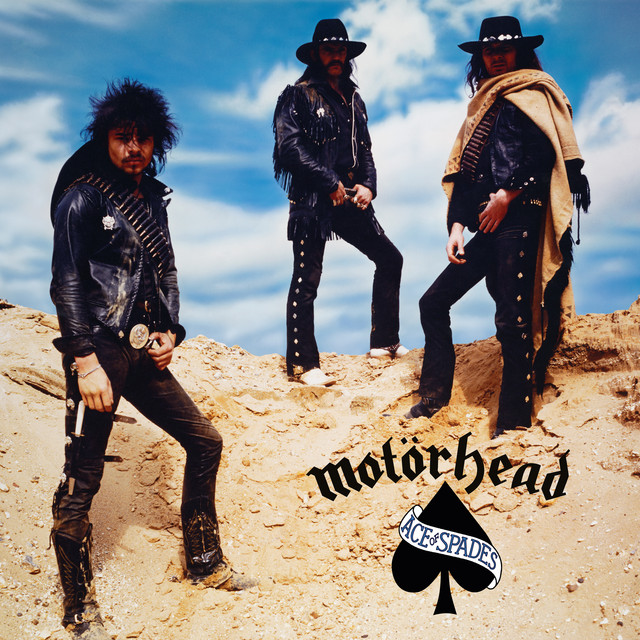
Lemmy Kilmister, “Fast” Eddie Clarke and Phil “Philthy Animal” Taylor made this twelve-song album with producer Vic Maile in 1980. Bass and vocals, guitar and drums remain the basic three-person arrangement. The selection uses only the twelve original studio tracks from the 2020 anniversary master. The package’s later live performances, demos and alternate versions are excluded here. Its extended running time should not be mistaken for the dimensions of the original album.
A benchmark at the beginning
The title track establishes a forceful identity in roughly two minutes and forty-six seconds. Once its familiar riff is recognised, consider what bass and drums contribute to keeping that short figure moving. Three performers need not produce a thin arrangement. Their roles can create density through participation in the song’s propulsion, which is a different question from simply increasing playback volume.
Movement between songs
Shoot You in the Back, Fire Fire and Dance are compact units within the sequence. Bringing on the next beginning promptly offers a different source of motion from extending one piece through many transformations. Instead of deciding first whether the album belongs to metal or punk, consider the succession of these units. Genre distinctions need not disappear for song length and placement to deserve their own attention.
The longest is not the last
After Bite the Bullet, the four-minute-and-fifteen-second Chase can feel comparatively expansive. It is the longest studio track in the selected programme. The Hammer then closes on a smaller scale, declining to make the largest piece the destination. These proportions remain distinct within the rough overall sound. Compare duration with felt momentum before remembering the album as one uninterrupted block of speed.
The album through its tracks
Compare the opening title track with The Chase Is Better Than the Catch, then notice the changing lengths of the final three songs.
Ace of Spades
At about two minutes and forty-six seconds in this edition, the opening establishes a benchmark quickly. Its fame should not make the remaining eleven songs redundant. If the riff is familiar, shift attention towards the bass and drums that help keep its shape in motion. Treating vocals and guitar as the only foreground elements can obscure the interaction of a three-person band. Propulsion is not simply a result of turning up the volume: recurring material and compact proportions work together. Retain this opening as a reference when reaching The Chase Is Better Than the Catch. A broadly similar sound can occupy a different span, making the signature song a measure rather than a stopping point.
Reference · BMG official: 1980 trio, Vic Maile and twelve-song albumThe Chase Is Better Than the Catch
The eleventh track is the longest in the selected studio programme, at approximately four minutes and fifteen seconds. Its predecessor, Bite the Bullet, lasts just one minute and thirty-seven seconds, sharpening the contrast. Length does not automatically make this a slow ballad or a monumental epic. It is a point where the same band occupies more time within a sequence of compact songs. The ending also matters: The Hammer still follows. Set aside the expectation that the longest piece must provide the final destination, and consider the return to a shorter closing unit. Maintaining energy and making every song equally long are separate decisions; the sequence makes that distinction useful to hear.
Reference · Qobuz licensed distribution: complete original twelve-track sequence and timings
Listen next
Compare Back in Black’s fit between riffs and pulse with the momentum generated here by a succession of compact songs.
Back in Black ↗References & editorial note
Written for English readers. Album facts are referenced below; listening suggestions are editorial interpretations. AI-assisted editorial review; not independently human-reviewed.
- BMG official: 1980 trio, Vic Maile and twelve-song album · www.bmg.com
- Motörhead official: 2020 anniversary master and separate live material · imotorhead.com
- Qobuz licensed distribution: complete original twelve-track sequence and timings · www.qobuz.com
- Apple Music: anniversary package, original twelve studio tracks selected · music.apple.com