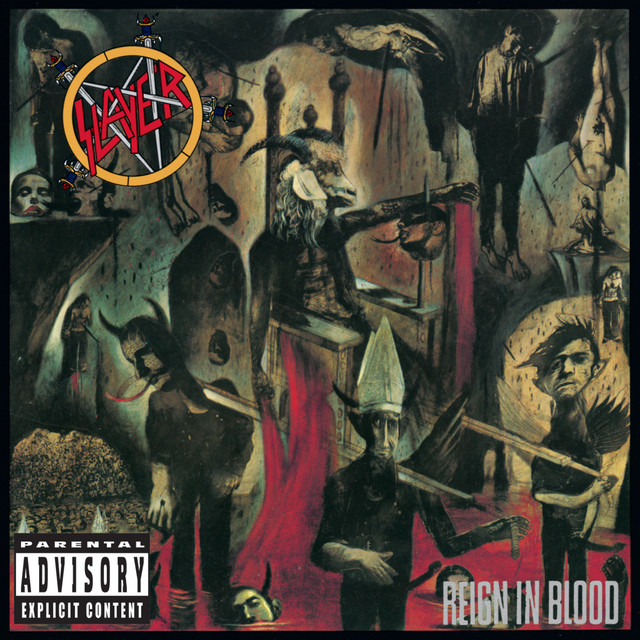
Rock / Hard rock & heavy metal · 1986
Reign in Blood
Slayer
Why listen
A compressed ten-track programme under half an hour gives brief units and a comparatively longer finale different responsibilities.
Listen and read
Tracks · previews
English editorial edition
Album story
Calling Reign in Blood fast can obscure the question of what changes within its short duration. The speed at which one track ends and another arrives is not identical to the pace of performance. If extended metal compositions are the expectation, these compressed units require another kind of attention. Instead of waiting for each song to grow large, notice material appearing, yielding and passing into the next piece. Brief does not necessarily mean light or easy.
Slayer’s 1986 studio album involved producer Rick Rubin and the band of Tom Araya, Jeff Hanneman, Kerry King and Dave Lombardo. The original ten songs occupy approximately twenty-nine minutes. This selection retains that order without expanded-edition additions. The later Still Reigning performance can reproduce the programme while remaining a different recording. Identical titles and order do not establish a studio/live match. This is a distribution of the original studio programme, without a claim of identical original mastering.
Deciding when to stop
The third track, Necrophobic, lasts around one minute forty seconds here. Habits formed around a distant returning refrain may not fit that span. Notice the decision to move onwards rather than explain an idea at length. Brevity need not signify incompletion. What stays and where a piece ends are compositional choices. Distinguishing the ten units reveals endings and neighbouring entrances within the overall pressure.
Separate jobs inside the force
Instruments sounding forceful together need not perform the same task. Consider the guitar’s recurring shape separately from moments when drums redirect movement. Their combined pressure can make individual roles harder to distinguish. There is no need to analyse every note immediately; ask whether one change draws another along. A sense of many sounds differs from evidence that no relationships can be heard.
The proportions of a finale
Postmortem leads into Raining Blood. The last track occupies a broader span than the short central items, after their compression has accumulated. Its time has another position when heard after nine tracks rather than alone. The closing impression depends on the proportions already encountered, not only on the title. Replay the finale alone and then from track nine: the same piece can register differently as an independent scene and as the act of closing an album.
The album through its tracks
Compare the brief Necrophobic with the closing Raining Blood, approaching the latter through Postmortem as well as hearing it alone.
Necrophobic
The third track lasts approximately one minute forty seconds in this distribution. A listening habit formed by longer songs may make it seem over before it has properly begun. Before interpreting that as insufficient length, consider what has been presented and then handed onwards. A short piece can decide its ending quickly rather than enlarge one idea indefinitely. Within the joint pressure of guitar and drums, notice whether both change identically or contribute different kinds of redirection. Hearing every note is not an entrance examination. Compare Raining Blood: a brief unit moving through the album and a broader span responsible for closing it have different functions. Short time need not imply little weight.
Reference · Slayer official: original ten-track order and album durationRaining Blood
This is the tenth and final track; its title differs in spelling from the album’s Reign in Blood. At just over four minutes in the chosen distribution, it occupies more space than the shortest central items. Hear that duration after nine preceding tracks rather than only as an isolated number. Beginning with Postmortem preserves the route into the finale. A forceful image should not explain every musical change: consider how guitar patterns, drums and voice contribute to closure. Unlike an expanded edition with bonuses afterwards, this ten-track programme ends here. Keeping the song’s ending aligned with the album’s ending makes the choice of conclusion clearer within the compact overall design.
Reference · Slayer official: original ten-track order and album duration
Listen next
Compare the other 1986 album Master of Puppets, where extended sections unfold, with this compressed sequence of shorter units and its different scale of metal.
Master of Puppets ↗References & editorial note
Written for English readers. Album facts are referenced below; listening suggestions are editorial interpretations. AI-assisted editorial review; not independently human-reviewed.