Rock / Singer-songwriters & American rock · 1969
The Band
The Band
Why listen
Twelve compact songs make changing singers and instrumental roles the substance of a shared band identity.
Listen and read
Tracks · previews
English editorial edition
Album story
Start with the handover between singers. Richard Manuel fronts Across the Great Divide, Levon Helm follows on Rag Mama Rag, and Rick Danko takes When You Awake. These are distinct entrances into the same record. The supporting voices matter as much as the changes of lead: a musician who occupied the foreground can become part of somebody else’s setting. The album title begins to sound like a practical description of that arrangement.
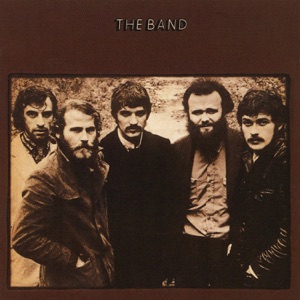
Released in 1969, the group’s second studio album contains twelve original songs. This presentation uses the current Capitol remastered programme, separately from the 2019 Bob Clearmountain remix. Its domestic recording setting in Los Angeles and collaboration with John Simon help locate the project, but the brown cover should not determine every expectation. An apparently old-fashioned scene can contain an electrically altered keyboard sound.
Different jobs for keyboards
Hudson identified Rag Mama Rag as one of his piano performances in an interview. Compare that role with the wah-treated clavinet on Up on Cripple Creek. The useful distinction is less a catalogue of instruments than a change in how the accompaniment articulates the song. A keyboard can establish weight, supply a countergesture or make the rhythm feel unusually springy without becoming a long solo.
Scale through sequence
Most tracks occupy three or four minutes. The record develops by changing scenes rather than extending one performance indefinitely. Whispering Pines gives way to Jemima Surrender; their different temperaments become clearer through adjacency. Similar running times leave room for remarkably different shapes. Try keeping the sequence intact before returning to the singles, so that the quieter songs retain their place in the argument.
Two closing portraits
The Unfaithful Servant and King Harvest finish the programme with different protagonists and different lead singers. Danko and Manuel do not deliver interchangeable conclusions. The shift leaves the album open to more than one kind of experience. Returning to the beginning after those songs makes the collective title feel earned by the music’s distribution of roles, rather than simply printed above a collection of hits.
The album through its tracks
Compare the early changes of singer and the clavinet on track five, then continue through the two closing songs.
The Night They Drove Old Dixie Down
Helm leads the third track, a Robertson composition built around a Civil War-era character. The musical entrance is the distinction between the narrative delivery and the moments supported by additional voices. Follow the expansion without treating every phrase as equally emphatic. Rag Mama Rag, immediately before it, offers a useful comparison: the same singer can occupy a very different dramatic setting. This selection is the studio performance within the original album programme, not a later concert rendition or a cover. Its compact duration also matters. The song gathers its effect through recurring sections rather than the extended instrumental development that might turn a historical subject into a much larger suite.
Reference · Universal Music Canada — original programme and distinct 2019 remixUp On Cripple Creek
Hudson’s clavinet through a wah pedal gives the fifth song an unusually mobile keyboard colour. His interview discusses the combination while declining certainty about who used it first. The interesting question here is its function within this particular performance. Listen for the short keyboard responses around Helm’s lead, and distinguish their clipped attack from a sustained organ texture. The effect contributes to the rhythmic character instead of arriving as a decorative solo. Continue into Whispering Pines to hear how strongly the following song changes the setting. This is the regular album take in the twelve-song programme; the earlier and alternate versions collected on expanded editions are separate performances.
Reference · The Acoustic Storm — Garth Hudson interview, October 2004
Listen next
Continue with Woody Guthrie’s Dust Bowl Ballads to compare character-centred storytelling in a varied band arrangement with the more compact resources of folk accompaniment.
Dust Bowl Ballads ↗References & editorial note
Written for English readers. Album facts are referenced below; listening suggestions are editorial interpretations. AI-assisted editorial review; not independently human-reviewed.
- Universal Music Canada — original programme and distinct 2019 remix · www.universalmusic.ca
- The Acoustic Storm — Garth Hudson interview, October 2004 · www.acousticstorm.com
- Qobuz / Capitol — twelve-track programme, credits and durations · www.qobuz.com
- Apple Music — twelve-track Remastered delivery · music.apple.com